

Ethical AI Use in Academic Writing: A Practical Student Checklist
AI tools can make academic writing easier, but using them responsibly is critical. Here's what you need to know:
- Key Principles: Always prioritize your own ideas, be transparent about AI use, credit AI contributions, and ensure your work reflects your original thinking.
- Institution Policies: Check your university's rules on AI. Policies vary, and misuse can lead to severe penalties like failing grades or expulsion.
- Practical Tips:
- Use AI writing assistants for brainstorming, outlining, or grammar checks - not for writing final drafts or conducting analysis.
- Review and edit AI outputs to ensure they align with your voice and understanding.
- Verify AI-generated citations; many are inaccurate or fabricated.
- Disclose your AI usage clearly if required by your institution.
Bottom Line: AI should assist, not replace, your efforts. Stay honest, follow the rules, and ensure your work reflects your learning and critical thinking.
Using AI Ethically in Research and Writing
sbb-itb-1831901
Understanding Academic Policies on AI Use
Before diving into any AI tool for academic work, it's crucial to check your institution's policies. By early 2026, over 80% of college students were using AI tools for their studies. However, what's allowed can vary significantly - not just between universities but even among courses at the same school. What might be fine in one class could lead to trouble in another. Here's how to navigate these policies and avoid penalties while staying ethical.
Review Your University's Guidelines
Start by reviewing the guidelines set by your university, department, and individual courses to understand what counts as acceptable AI use. The syllabus is your first stop, as instructors often have stricter rules than the broader university policy. These course-specific rules can help you figure out how AI tools can (or cannot) fit into your academic work.
Most policies distinguish between AI as a support tool and as a substitute. For example:
- Generally allowed: Using AI to brainstorm ideas, check grammar, or create an outline.
- Not allowed: Using AI to write your final draft, conduct original analysis, or craft conclusions.
If the syllabus doesn’t mention AI, assume it’s off-limits unless your instructor explicitly says otherwise.
"If you are unsure of the instructor's expectations or cannot get clarification, the chart directs them to not use GenAI on the assignment." - Oregon State University
Know the Consequences of Misuse
Misusing AI can lead to serious academic penalties. Depending on the institution and the severity of the issue, consequences range from a zero on the assignment to failing the course, academic probation, or even expulsion. Oregon State University outlines three types of AI-related misconduct:
- Plagiarism: Submitting AI-generated text without proper citation.
- Cheating: Using AI tools without authorization.
- Fabrication: Turning in AI-created but fake citations or data.
AI-generated references, in particular, require extra caution. Even if the error is unintentional, fabricated citations are treated as serious violations. Remember, you are fully responsible for everything you submit.
"AI can help, but you are accountable for what you submit. AI might give false or biased info - always double-check." - Drexel University
Understanding these policies is essential for following the ethical AI checklist discussed later in this guide.
Ethical AI Use Checklist for Students
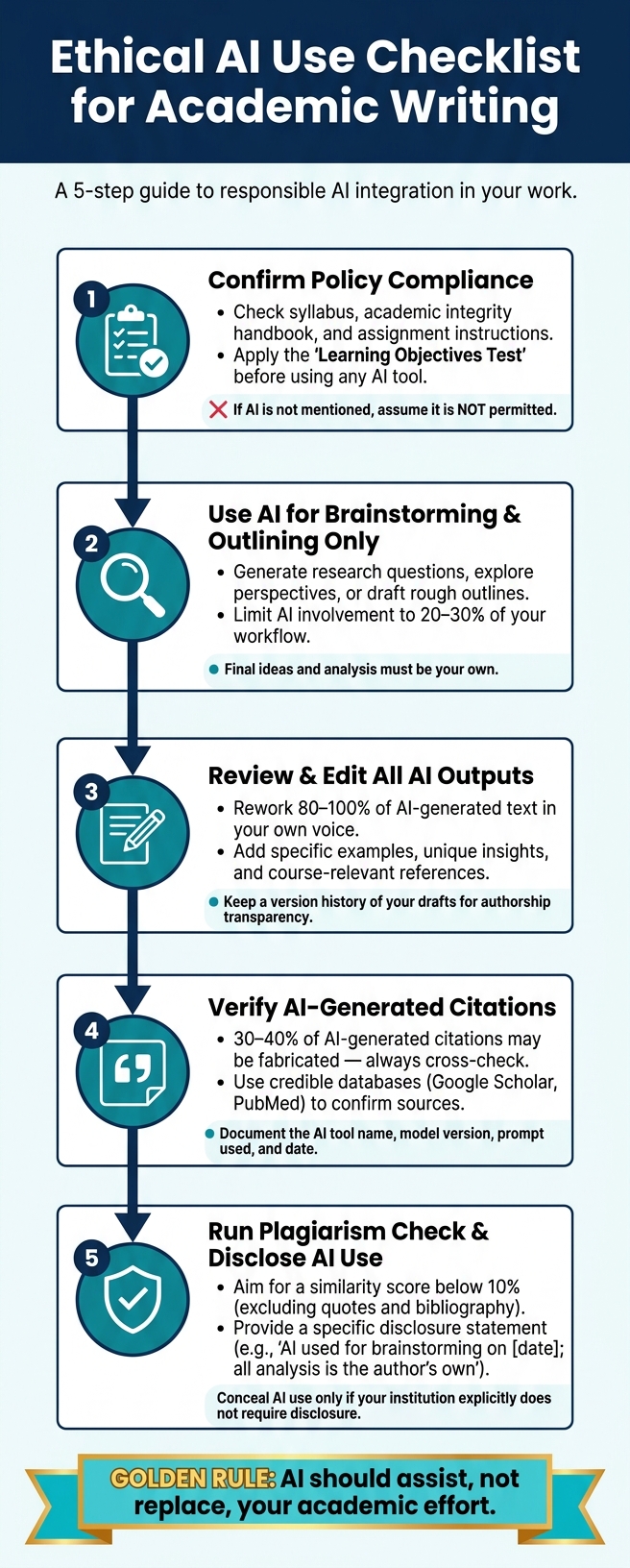
Ethical AI Use Checklist for Academic Writing
Now that you have a grasp of your institution's policies and the potential consequences of misuse, here's a practical checklist to guide you through the writing process responsibly.
Confirm Policy Compliance
Before diving into any AI tools, double-check your syllabus, the academic integrity handbook, and assignment instructions. Policies can vary significantly - not just between schools, but even between different courses at the same institution. If there’s no mention of AI, don’t assume it’s permitted. A quick question to your instructor can save you from serious trouble.
Use the "Learning Objectives Test" to determine whether AI use aligns with the assignment’s purpose. For example, if the goal is to develop your argumentation skills, the argument itself should come from you. Once you’re sure your AI use complies with the rules, you can move forward and use the tool as a brainstorming aid.
Use AI for Brainstorming and Outlining
AI can be a helpful collaborator during the early stages of your work. Use it to generate research questions, explore various perspectives on a topic, or create a rough outline. The key is ensuring that your final product reflects your own analysis and thought process - not the AI’s. Limit AI involvement to about 20–30% of your workflow to ensure the core ideas remain yours.
"AI should enhance, not replace, your academic effort." - Chloe Bouchard, Author
Review and Edit All AI Outputs
To maintain academic integrity, thoroughly review and edit any output from an AI tool. AI-generated text can often sound generic, so personalize it by adding specific examples, unique insights, and varied sentence structures. Rework flagged sections in your own voice, drawing on course readings or class discussions for added depth.
It’s also a good idea to keep a version history of your work. This way, if questions about authorship arise, you’ll have a clear record of how your ideas and drafts evolved.
Verify AI-Generated Citations
Citations are a cornerstone of academic work, and accuracy is non-negotiable. Studies suggest that 30–40% of AI-generated citations are fabricated. This means the referenced articles, books, or studies may not even exist. Always cross-check AI-suggested citations using credible databases to ensure their validity.
"Never cite AI for ideas without verification - venerate the original sources AI references." - Emily Grant, Academic Guidance Specialist, Paper Checker
Document the AI tool you used, including its name, model version, the exact prompt, and the date of the response. This provides transparency and serves as a methodology if your instructor asks about your sources.
Run Plagiarism Checks and Disclose AI Use
Before submitting your work, run it through a plagiarism checker for academic papers to identify sections that might unintentionally mimic published content or exhibit AI patterns. Even with low false positives, this extra step ensures your work is entirely your own.
If your institution requires AI use disclosure, be specific. A vague statement won’t cut it. For example, you might write: "AI was used for brainstorming research questions on [date]; all arguments and analysis are the author's own." Tailoring your disclosure to the actual level of assistance demonstrates honesty and protects you if questions arise.
| Disclosure Level | Example Statement |
|---|---|
| Brainstorming only | "AI was used to generate initial research questions; all analysis is the author's own." |
| Proofreading only | "AI tools were used for grammar and clarity checks; no content was generated by AI." |
| Summarization | "AI assisted in summarizing source material; all interpretations are the author's own." |
How to Use Yomu AI Ethically in Your Writing Process
Ensuring the integrity of your academic work means using Yomu AI tools responsibly. This section breaks down how to ethically incorporate Yomu AI's features - like autocomplete, paraphrasing, summarization, citation formatting, and plagiarism checking - into your writing process. These tools are designed to assist, not replace, your research and writing efforts.
"Yomu is meant to be used in conjunction with, not as a replacement for, the student's own writing and research abilities." - Yomu AI Ethics Statement
Using Autocomplete for Drafting
Yomu AI's autocomplete feature can help you flesh out ideas or improve transitions between points. Think of it as a drafting assistant - not a substitute for your own writing.
Always review and revise autocomplete suggestions thoroughly. Aim to rework 80–100% of the generated text to ensure it aligns with your voice and intent. According to Yomu AI's 2025 transparency report, about 15% of AI-generated completions may contain errors. This highlights the importance of manual oversight.
Using Paraphrasing and Summarization Tools
The paraphrasing tool offers alternative ways to phrase selected text, while the summarization feature condenses longer content into bullet points or abstracts. These tools can be particularly helpful for tasks like literature reviews or note-taking, but they require careful validation.
Paraphrased content can sometimes distort the original meaning. For instance, a claim of "20% efficiency increase" might mistakenly be interpreted as "efficiency doubled." Always cross-check paraphrased text with the original source to ensure accuracy. Similarly, use summarization tools for brainstorming or drafting notes, but avoid relying on them for final versions of your work.
Formatting Citations and Checking for Plagiarism
Yomu AI can auto-generate citations in various styles using details like a DOI, title, or URL. However, treat these outputs as starting points. Errors can occur, especially with complex references - Purdue OWL (2026) notes a 10–15% error rate for such cases. Double-check details like author names, publication dates, and page numbers before finalizing your citations.
When your draft is complete, use Yomu AI's plagiarism checker to ensure originality. Aim for a similarity score below 10%, excluding direct quotes and your bibliography. If flagged sections appear, rework them in your own words or add proper citations. These steps help uphold the ethical standards outlined earlier in this guide.
Do's and Don'ts of AI Use at Each Writing Stage
Understanding when and how to use AI can mean the difference between a helpful tool that supports your learning and one that undermines it. Here's a practical guide to using AI responsibly throughout the writing process.
Research Stage
At the research stage, AI can assist in overcoming writer's block by summarizing articles, identifying research gaps, and generating initial questions. For instance, in 2025, Dr. Elena Vasquez used an AI tool integrated with Google Scholar to map interdisciplinary citations for her climate study in Nature Ecology & Evolution. She manually refined every AI-generated summary and cited the tool in her methodology.
However, be cautious of one major risk: citation fabrication. AI tools sometimes "hallucinate" references, inventing authors, titles, or publication dates that don't exist. Always verify AI-suggested sources through reputable databases like Google Scholar or PubMed before using them.
"AI can be a valuable tool for assistance but is not an accountable entity for the research outcomes since the ultimate responsibility of research lies with the human." - UW Graduate School
Drafting Stage
When drafting, think of AI as a thinking partner. It can help you refine your thesis, suggest a clearer outline, or point out gaps in your argument. However, it's best to draft your own version first and then use AI to refine the structure. Replace any generic AI-generated sentences with your own specific and original content.
"Prompt for help with thinking, not impersonation." - Ilia Ilinskii, Rephrase
Once your draft is complete, focus on improving clarity and ensuring the content reflects your authentic voice.
Editing and Rewriting Stage
AI tools for paraphrasing and grammar can help improve clarity and flow, especially for those who are non-native English speakers. That said, avoid letting AI rewrite your core arguments or theoretical interpretations. These are the elements your instructor is evaluating, and they should be entirely your own.
"AI should enhance, not replace, your academic effort." - Chloe Bouchard
If any section appears overly AI-generated, adjust the rhythm of your sentences and add your interpretation to maintain authenticity. After editing, prepare for the final checks to ensure your work meets academic standards.
Finalizing Stage
Before submitting your work, make sure to follow these ethical practices:
| Task | Ethical "Do" | Unethical "Don't" |
|---|---|---|
| Citations | Verify all references for accuracy and existence | Submit without confirming citations |
| Plagiarism Check | Run a check and revise flagged sections | Ignore flagged content and submit unchanged |
| Disclosure | Clearly state which AI tools you used and how (e.g., in a footnote or methodology) | Conceal AI use when your institution requires disclosure |
Here’s an example of a disclosure statement: "AI tools were used for proofreading and minor language refinement. All ideas and substantive content remain entirely my own work."
Lastly, save your draft history. Version logs can serve as evidence of your writing process if your work is ever questioned.
Conclusion: Using AI Responsibly for Academic Success
AI tools can be a great asset for academic writing, but the key is making sure you're always in the driver’s seat. Let’s revisit the essentials of using AI ethically in your academic work.
"Academic work should represent a meaningful original contribution that demonstrates your understanding, critical thinking, and engagement with the subject. Tools may assist this process but should not substitute for your intellectual input." - Yomu.ai
Before submitting your work, take a moment for a quick Integrity Test: Can you confidently defend every claim you’ve made? Do you understand the purpose of each paragraph? Can you trace every source back to its origin? If you can answer "yes" to all of these, then you’re using AI properly - as a tool to refine and support your own ideas, while ensuring your work remains authentically yours.
The golden rule? AI should support your process, not take over. Start by drafting your core ideas yourself. Then, let AI help with polishing - whether that’s improving clarity, fixing errors, or stress-testing your arguments. This approach ensures your critical thinking and personal voice remain at the forefront, which is exactly what educators look for.
If you’re ever unsure about your institution’s policy, err on the side of transparency. Clearly document the AI tool you used, what tasks it assisted with, and when it was applied. Adding a simple footnote not only safeguards your academic integrity but also reinforces your credibility.
"Academic integrity in 2025–2026 is no longer just about avoiding plagiarism; it's about transparency, authorship, and digital ethics." - JustDone
FAQs
How do I know if AI is allowed for this assignment?
To determine if using AI tools is permitted, start by reviewing your course syllabus and any guidelines provided by your instructor. Policies can vary widely depending on the course or institution. Look for specific mentions of whether AI use is allowed, restricted, or requires disclosure. If the policy isn’t clear, reach out to your instructor or academic advisor for clarification. If AI use is permitted, make sure to disclose it and cite the tools properly to uphold academic integrity and maintain transparency.
What should I include in an AI-use disclosure?
When using AI tools in your work, it's crucial to be transparent about their role. Clearly outline the types of assistance the AI provided, such as paraphrasing or summarizing, and identify any content generated by these tools.
Additionally, make sure your disclosure complies with your institution’s guidelines to uphold academic integrity. This ensures your work remains honest and credible while respecting the rules in place.
How can I confirm AI-generated citations are real?
Manually verify AI-generated citations by searching for the referenced sources through trusted academic platforms like Google Scholar, PubMed, or other reputable databases. Pay close attention to details such as author names, article titles, journal names, and DOI numbers to confirm they correspond to genuine, credible publications. Avoid relying entirely on AI-generated citations - always cross-check to ensure accuracy and prevent using incorrect or fabricated references.