

Chicago Style In-Text Citations: Quick Reference Guide
Understanding Chicago-style citations can feel overwhelming, but it boils down to two main systems: Author-Date and Notes and Bibliography. Each serves different fields and has unique formatting rules. Here's what you need to know:
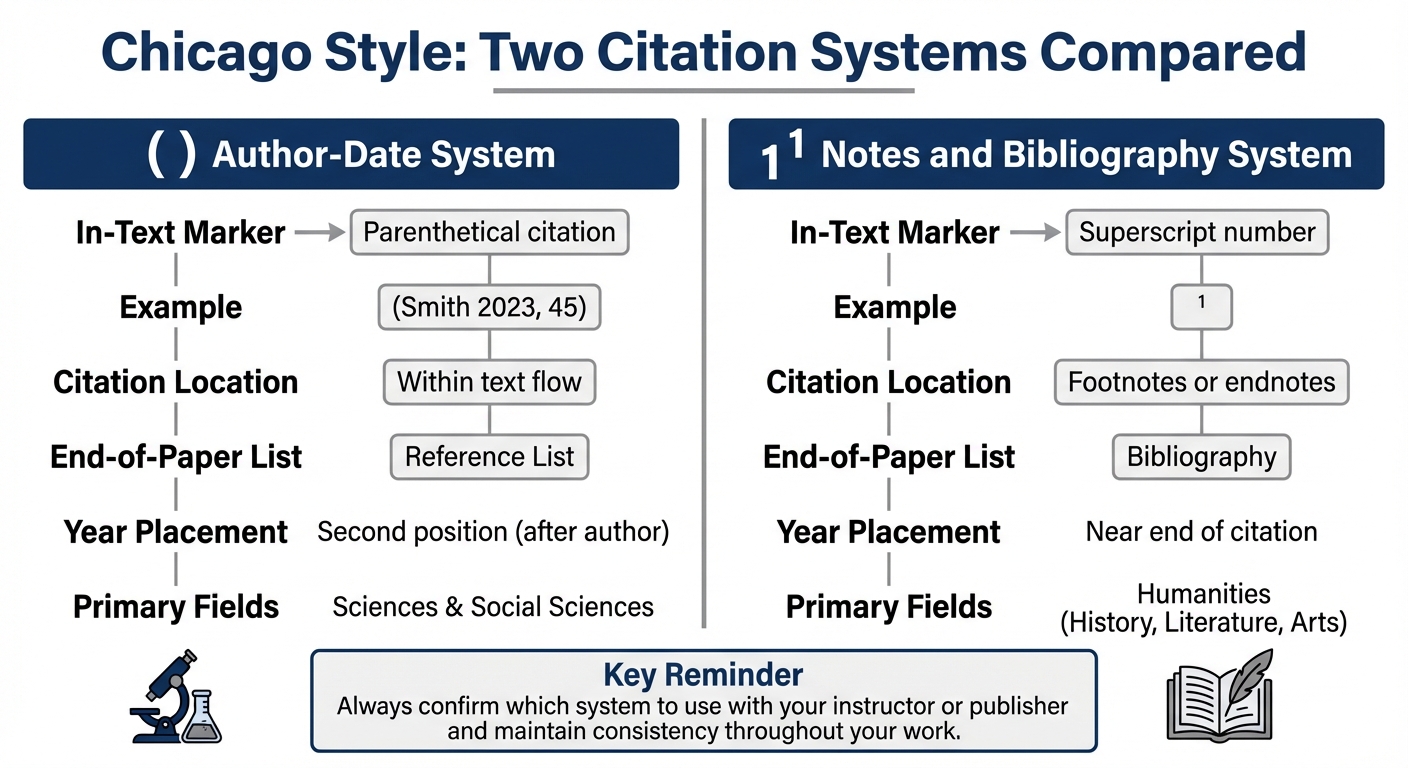
- Author-Date: Common in sciences and social sciences, it uses parenthetical in-text citations (e.g., (Smith 2023, 45)) and a detailed reference list at the end.
- Notes and Bibliography: Preferred in humanities like history and literature, it relies on superscript numbers in the text, linking to footnotes or endnotes, along with a bibliography.
Key differences include:
- In-text markers: Parentheses (Author-Date) vs. superscript numbers (Notes and Bibliography).
- End-of-paper lists: Reference List (Author-Date) vs. Bibliography (Notes and Bibliography).
- Fields: Sciences favor Author-Date, while humanities lean toward Notes and Bibliography.
Both systems aim to provide clarity, credit sources, and avoid plagiarism. Whether you're citing books, articles, or web pages, consistency is critical. Always confirm with your instructor or publisher which system to use, and stick to it throughout your work.
Chicago Style Citation Systems: Author-Date vs Notes and Bibliography Comparison
Chicago Citation Style: In Text Citations & Footnotes
The Two Chicago Citation Systems
Chicago style provides two distinct methods for citing sources, and knowing which one to use is key to aligning with your academic or professional field's standards.
Author-Date System
The Author-Date system integrates citations directly into your text using parentheses. These in-text citations include the author's last name, the year of publication, and, if relevant, a page number. For example: (Grazer and Fishman 2015, 12). This method is clean and keeps the flow of your writing uninterrupted.
The Chicago Manual of Style explains:
"Because it credits researchers by name directly in the text while at the same time emphasizing the date of each source, the author-date system is preferred by many in the sciences and social sciences." - The Chicago Manual of Style
At the end of your paper, you'll include a Reference List where each source is detailed in full. In this list, the publication year is placed immediately after the author's name, making it easy to assess the timeliness of the sources. For example:
Grazer, Brian, and Charles Fishman. 2015. A Curious Mind: The Secret to a Bigger Life. New York: Simon & Schuster.
This system is widely used in disciplines such as the physical sciences, natural sciences, and social sciences.
On the other hand, the Notes and Bibliography system offers a more traditional, footnote-based format.
Notes and Bibliography System
The Notes and Bibliography system uses superscript numbers (e.g., ¹) within the text, which correspond to footnotes at the bottom of the page or endnotes at the end of the document. These notes provide full citation details. For example, a footnote might look like this:
- Zadie Smith, Swing Time (New York: Penguin Press, 2016), 315–16.
This system is particularly suited for humanities fields like history, literature, and the arts. It shines when dealing with unconventional sources or when you want to include additional commentary about a source without breaking the narrative flow of your text. At the end of your work, you'll compile a Bibliography that lists all sources alphabetically. Unlike the Author-Date system, the publication year in this format appears later in the citation, near the end.
| Feature | Author-Date System | Notes and Bibliography System |
|---|---|---|
| In-Text Marker | Parenthetical (Author Year, Page) | Superscript number (¹) |
| Citation Location | Within the text flow | Footnotes or endnotes |
| Primary Fields | Sciences and social sciences | Humanities (history, arts, literature) |
| End-of-Paper List | Reference List | Bibliography |
| Year Placement | Second position, after author's name | Near the end of the citation |
Before you begin, consult your instructor or publisher to confirm which system is required. Once you've chosen a citation style, stick with it consistently throughout your paper - mixing the two systems is a big no-no.
How to Use Author-Date Citations
Basic Format and Where to Place Citations
The Author-Date citation format is simple: author's last name, a space, and the year of publication. If you're referencing a specific page or section, add a comma after the year, followed by the page number. For example, (Smith 2016, 10).
Citations should be placed in parentheses at the end of the sentence, before the period. For instance: (Grazer and Fishman 2015, 12). Notice that the period comes after the closing parenthesis.
If you mention the author's name within the sentence, you only need to include the year (and page number, if needed) in parentheses immediately after the name. For example: In a 2016 study, Zadie Smith (2016, 315–16) examined themes of movement and identity. This approach keeps the flow of your writing smooth while still giving appropriate credit.
Spacing Tip: Always use a single space between the author's name and the year - never a comma unless you're adding a page number. Next, let’s look at how to handle citations with multiple authors.
Citing Multiple Authors and Using Et Al
How you cite multiple authors depends on the number of contributors:
- For two authors, list both names separated by "and": (Grazer and Fishman 2015, 12).
- For three authors, the Chicago Manual of Style (17th edition) suggests listing all three names with commas, using "and" before the last name: (Berman, Bauer, and Nold 2011, 7). The 18th edition, however, allows the use of "et al." for three or more authors.
- For four or more authors, list only the first author's last name followed by "et al." (which means "and others"). For example: Recent studies highlight evolving patterns in environmental response systems (Bay et al. 2017, 465). Remember, "et al." is not italicized, and it includes a period as it’s an abbreviation.
Here’s a quick reference table to clarify:
| Number of Authors | In-Text Citation Format | Example |
|---|---|---|
| 1 Author | (Author Year, Page) | (Smith 2016, 10) |
| 2 Authors | (Author1 and Author2 Year, Page) | (Grazer and Fishman 2015, 12) |
| 3 Authors | (Author1, Author2, and Author3 Year, Page) | (Berman, Bauer, and Nold 2011, 7) |
| 4+ Authors | (Author1 et al. Year, Page) | (Williams et al. 2018, 2) |
Now, let’s move on to handling situations where author or date details are missing.
What to Do When Author or Date Is Missing
Even if a source lacks an author or date, you can still cite it correctly. If no author is listed, use the title of the work in place of the author's name. Italicize book titles and use quotation marks for articles. Example: (The Chicago Manual of Style 2017, 908). If the author isn’t clear, check the "About" section or copyright page of the source - sometimes an organization or sponsor can be credited as the author.
For sources without a publication date, use "n.d." (short for "no date") in place of the year. In these cases, include a comma before "n.d.": (Yale University, n.d.). For example: Yale University shares details about its history and campus (Yale University, n.d.). When using "n.d." in a citation, always provide an access date in the reference list, especially for online sources, as digital content can change or disappear over time.
For e-books without page numbers, reference a chapter or section instead. For example: Austen (2007, chap. 3) discusses the social hierarchy in her analysis of classic literature. If no locator is available, you may omit it - just ensure the author and year are included.
sbb-itb-1831901
How to Use Notes and Bibliography Citations
Using Footnotes and Endnotes
In the Notes and Bibliography system, citations are marked with superscript numbers that correspond to full details provided in either footnotes or endnotes. These superscript numbers are placed at the end of a sentence, following punctuation marks like periods and closing quotation marks.
Footnotes appear at the bottom of the same page, making it easy for readers to access the citation without flipping pages. Endnotes, on the other hand, group all references at the end of the document, keeping the main pages clean and uncluttered. Both formats follow identical citation rules - the difference lies only in where they appear. Most word processors have built-in tools for inserting footnotes or endnotes, so make use of those features.
When citing works with up to three authors, include all their names. For works with four or more authors, list the first author followed by "et al." If you need to cite multiple sources in one note, separate them with semicolons. Once you've covered the basics, you can move on to managing repeated citations with full and short notes.
Full Notes vs. Short Notes
The first time you cite a source, you’ll need to provide a full note. This includes all the publication details: the author’s complete name, the full title of the work, the place of publication, the publisher, the year, and the page number. For every subsequent citation of the same source, use a shortened note. These shorter references typically include the author’s last name, a shortened version of the title (if it’s longer than four words), and the page number.
Here’s a quick comparison of full and shortened note formats:
| Element | Full Note Format (First Mention) | Shortened Note Format (Subsequent) |
|---|---|---|
| Book (1 Author) | 1. Michael Pollan, The Omnivore's Dilemma (New York: Penguin, 2006), 90. | 2. Pollan, Omnivore's Dilemma, 115. |
| Book (2 Authors) | 1. Geoffrey Ward and Ken Burns, The War (New York: Knopf, 2007), 52. | 2. Ward and Burns, The War, 102. |
| Journal Article | 1. Donald Maletz, "Tocqueville's Tangents", American Political Thought 4, no. 4 (2015): 615. | 2. Maletz, "Tocqueville's Tangents", 617. |
For back-to-back citations of the same source, you only need to include the author’s last name and the page number. Keep in mind, if your paper doesn’t include a bibliography, you should always use a full note the first time you mention any source.
Once you’re comfortable with full and short notes, it’s time to understand how to handle repeated citations effectively.
Using Ibid for Repeated Citations
In earlier editions, "Ibid." (short for the Latin ibidem, meaning "in the same place") was commonly used to refer to a source cited in the immediately preceding note. However, current editions of The Chicago Manual of Style recommend against using "Ibid." Instead, they suggest using shortened citations - author's last name and page number - even for consecutive references. This method avoids confusion, especially in digital texts where hyperlinks can make it harder to trace prior citations.
That said, if your instructor or publisher still requires "Ibid.", use it sparingly. It should only refer to the citation directly above and must include the page number if it’s different (e.g., "Ibid., 28"). Otherwise, stick to the modern approach: "Rushdie, 28." This keeps things clear and consistent.
Special Cases and Formatting Rules
How to Cite Page Numbers and Quotations
When using Chicago style, some scenarios require specific citation approaches. Here's how to handle these special cases effectively.
For direct quotes or ideas, always cite the exact page. In the Author-Date system, include the page number after the year, separated by a comma: (Pollan 2006, 90). In the Notes and Bibliography system, the page number appears at the end of the note: "1. Michael Pollan, The Omnivore's Dilemma (New York: Penguin, 2006), 90."
Short quotations (fewer than 100 words) should be incorporated into your text with double quotation marks, followed by the citation immediately after the quote. For block quotations (100 words or more), indent the entire passage 0.5 inches from the left margin, skip quotation marks, and place the citation in parentheses after the final punctuation mark. Note that short quotes have citations before the period.
For sources without fixed page numbers, use alternative locators like chapters or sections, or omit the locator entirely. Examples include: (Author 2023, chap. 2) or "1. Author, Title, sec. 4".
When citing indirect sources (a quote found in another work), use "quoted in" to credit both sources. In the Author-Date system, it looks like this: (Said 1993, quoted in Cairns 2000, 103). In Notes and Bibliography, format it as: "1. Edward A. Said, Culture and Imperialism (New York: Knopf, 1993), quoted in A. Cairns, Citizens Plus (Vancouver: UBC Press, 2000), 103".
Quick Reference Table for Special Cases
The table below outlines common citation scenarios and their formatting in both Chicago systems:
| Citation Type | Author-Date System | Notes and Bibliography System |
|---|---|---|
| Multiple Authors (3+) | (First Author et al. 2023) | 1. First Author et al., Short Title, 45. |
| No Author | (Short Title 2023) | 1. Full Title (Place: Publisher, 2023), 12. |
| No Date | (Author n.d.) | 1. Author, Short Title (n.d.), 8. |
| Organization Author | (American Medical Association 2022) | 1. American Medical Association, Short Title, 33. |
| No Page Number | (Author 2023, chap. 1) or (Author 2023) | 1. Author, Short Title, sec. 2. |
For web sources without a publication date, use "n.d." (no date) and consider adding an access date. If citing journal articles without standard page numbers, use an article ID instead. Above all, consistency is key - choose a method and apply it uniformly throughout your work.
Conclusion and Practical Tips
Getting comfortable with Chicago style starts with choosing the right citation system for your field and sticking to it throughout your work. The Notes and Bibliography system is commonly used in humanities subjects like history and literature, while the Author-Date system is better suited for sciences and social sciences. Before diving in, check with your instructor or publisher to confirm which system you should use.
While both systems share rules for formatting author names and titles, they differ in how citations appear. In the Notes and Bibliography system, use shortened notes after the first full citation. For the Author-Date system, include "n.d." if a publication date isn't available. When citing online sources, opt for DOIs instead of URLs for journal articles, and only include access dates if no publication date is listed. For works with multiple authors, follow the "et al." rule: in the Author-Date system, use it for three or more authors, and in the Notes and Bibliography system, use it for four or more.
To make the process smoother, take advantage of digital tools. Platforms like Yomu AI can simplify citation management by automating formatting, ensuring consistency across lengthy documents, and cross-checking in-text citations with your bibliography or reference list. Its citation features handle tricky details - like managing shortened notes and complex source types - so you can focus on crafting your research and arguments instead of stressing over formatting.
FAQs
How do I choose between the Author-Date and Notes and Bibliography citation systems in Chicago style?
When choosing between the Author-Date and Notes and Bibliography systems, it largely comes down to your field of study and citation needs.
The Notes and Bibliography system is a go-to for humanities disciplines like literature, history, and the arts. It relies on footnotes or endnotes for citations, paired with a detailed bibliography. This format is perfect for works that require thorough source documentation.
On the other hand, the Author-Date system is tailored for sciences and social sciences. It uses concise in-text citations alongside a reference list, offering a cleaner, more streamlined approach for these fields. Always check your discipline's standards and your instructor's preferences before making your choice.
How do I cite a source in Chicago style if it doesn’t have a publication date?
If your source lacks a publication date, replace the year with "n.d." (which stands for "no date") in your Chicago-style in-text citation. This approach signals that the date is unavailable while keeping the citation properly formatted.
For example: (Author’s Last Name, n.d.). Before using this notation, make sure to thoroughly check the source to confirm that a publication date is genuinely missing.
How should I cite sources with multiple authors in Chicago style?
When you're citing a source with multiple authors in Chicago style, you should include all the authors' names in the first citation. For later references, only the first author's name is needed, followed by et al. to show there are additional contributors.
Here’s an example to illustrate:
- First citation: Jane Smith, John Doe, and Emily Clark, Title of the Work.
- Subsequent citation: Smith et al., Title of the Work.
This method ensures your citations stay clear and to the point while still giving proper credit to all contributors.