

Persuasive vs Argumentative Essay Topics: What to Pick
Choosing between a persuasive and argumentative essay topic isn't just about preference - it’s about matching your writing style to your goal. Persuasive essays aim to convince readers by appealing to emotions and values, while argumentative essays rely on logic, evidence, and counterarguments to explore a topic in depth. Here's a quick breakdown:
- Persuasive Essays: Use emotional appeal, personal beliefs, and rhetorical techniques to inspire action or agreement. Best for audiences already leaning toward your viewpoint.
- Argumentative Essays: Focus on evidence, research, and logical reasoning to present a balanced analysis. Ideal for skeptical or neutral audiences.
Key Differences:
- Tone: Persuasive essays are passionate; argumentative essays are formal and balanced.
- Evidence: Persuasive writing blends facts with emotional appeals; argumentative writing demands thorough, research-backed evidence.
- Purpose: Persuasive essays aim to convince; argumentative essays aim to inform and analyze.
Quick Tip: Check your assignment prompt for clues. Words like "convince" or "advocate" suggest a persuasive essay, while "investigate" or "evaluate" point to an argumentative essay. Tailor your topic to fit these requirements for better results!
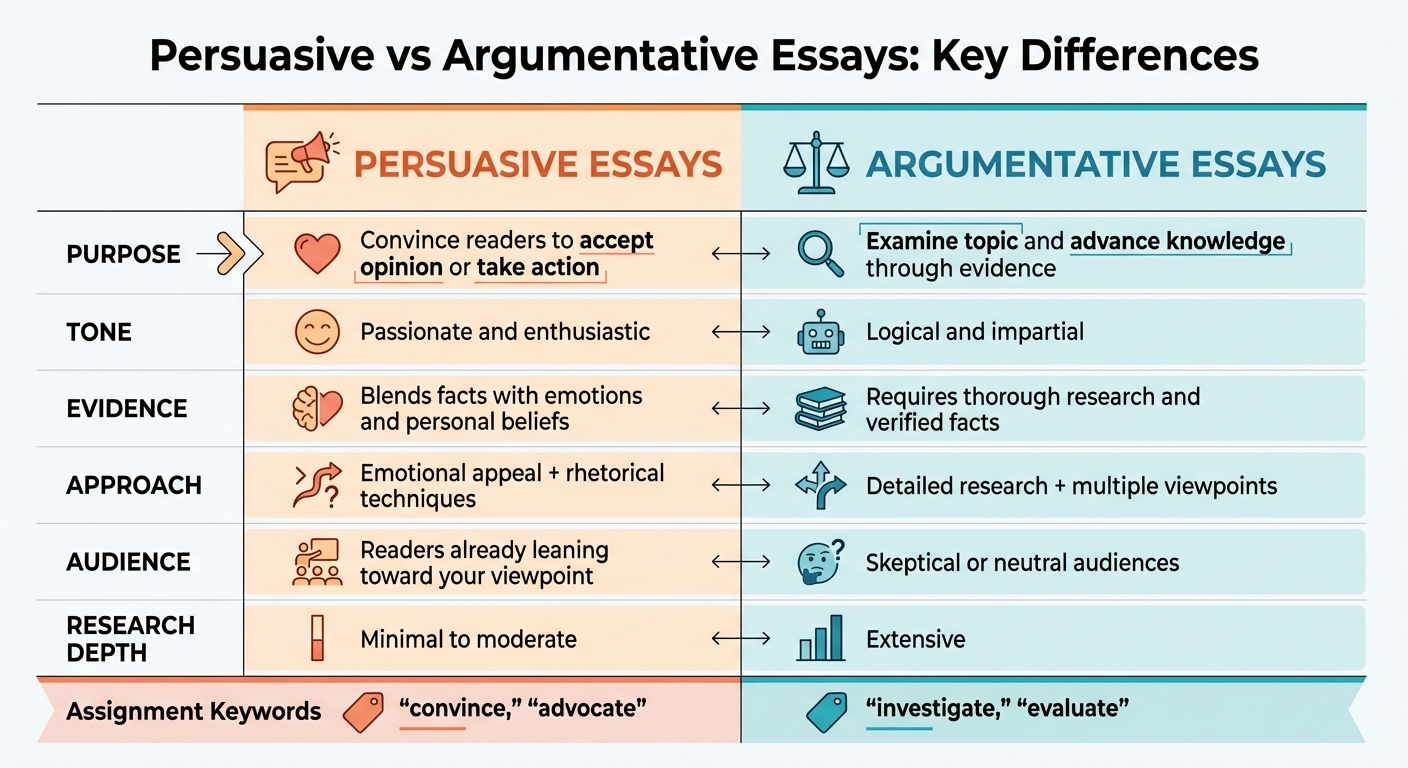
Persuasive vs Argumentative Essays: Key Differences Comparison Chart
Compare argumentative vs. persuasive writing
sbb-itb-1831901
1. Persuasive Essay Topics
Understanding how to choose persuasive essay topics is essential for aligning your writing style with your academic objectives.
Purpose
The main aim of a persuasive essay topic is to convince your reader to accept your opinion or take specific action. These essays go beyond presenting facts - they demonstrate how adopting your viewpoint benefits the reader.
For a topic to succeed, it must be "discussable", meaning it allows for multiple reasonable perspectives. For example, questions like "Should school days start later?" or "Are smartphones harming teen mental health?" spark genuine debate and encourage you to connect with your reader's values and concerns.
These elements shape how you craft your arguments and engage your audience.
Approach
Persuasive essays combine emotion, personal beliefs, and rhetorical techniques with logical reasoning to create compelling arguments. Show enthusiasm and conviction - your passion can make your case stronger.
"Find a subject you care about and which you in your heart feel others should care about".
While expressing passion, stay diplomatic.
"It is not persuasive to suggest that your opponents are morons... Give credit to your opponents; then clearly point out the weakness in their position".
Adopting a respectful tone enhances your credibility while still allowing you to advocate effectively for your stance.
Tone
The tone of persuasive writing is passionate and enthusiastic, aiming to influence the reader's beliefs or actions. State your thesis as a fact (e.g., "School days should start later") rather than framing it as a personal opinion to establish authority.
At the same time, balance your passion with respect for differing views. A tone that connects emotionally while showing you've thoughtfully considered all sides will resonate more deeply with your audience.
Once your tone is set, focus on choosing topics that matter to both you and your readers.
Topic Selection Strategies
Choose topics that genuinely interest you and narrow your focus to keep your argument manageable. Drawing from personal experience adds authenticity and helps you connect with readers. For instance, instead of tackling a broad subject like "technology", explore something more specific, like "the impact of smartphones on teen mental health".
Before finalizing your topic, test it out by discussing it with others. Doing so helps you anticipate objections and understand opposing views. Opt for issues tied to current debates, as these often strike an emotional chord with your audience. Lastly, position your strongest arguments at the beginning and end of your essay - these are the parts readers are most likely to remember.
2. Argumentative Essay Topics
Argumentative essay topics require a unique approach compared to persuasive ones. Instead of relying on emotional appeals, they focus on investigation, evidence, and logical reasoning.
Purpose
The main goal of an argumentative essay is to examine a topic, gather and assess evidence, and present a clear position. Unlike persuasive essays, which aim to sway opinions, argumentative writing seeks to advance understanding through evidence-based reasoning.
Humanities LibreTexts explains, "An argument is a reasoned opinion supported and explained by evidence. To argue in writing is to advance knowledge and ideas in a positive way."
For a topic to be suitable, it must be debatable - meaning there should be logical, evidence-based disagreement rather than personal bias. For instance, questions like "Should social media platforms be held accountable for spreading misinformation?" or "Should high schools adopt four-day weeks?" allow for multiple perspectives rooted in research.
Once you’ve identified a topic, the next step is to build your argument through thorough investigation.
Approach
Argumentative essays require detailed research and exploration of differing viewpoints . This often includes reviewing existing literature and using a variety of evidence to support your claims. A key part of the process is explaining why opposing views lack sufficient evidence.
Purdue OWL emphasizes, "It is unethical to exclude evidence that may not support the thesis."
Your argument should be supported by facts, statistics, and credible examples. Unlike persuasive essays, which may lean on personal conviction, argumentative essays rely on objective, research-driven analysis. This analytical approach strengthens your argument and ensures credibility.
Tone
Maintain a logical and impartial tone, showing respect for opposing viewpoints while presenting a well-reasoned analysis . When addressing counterarguments, focus on explaining why they are less supported by evidence rather than dismissing them entirely.
This balanced approach not only builds trust with your audience but also demonstrates that you’ve thoroughly considered all sides of the issue .
Topic Selection Strategies
Start by ensuring your topic has at least two evidence-backed perspectives. Before finalizing your choice, confirm that credible sources are available for all sides of the argument . Narrow down broad topics to specific, focused questions. For example, instead of tackling "technology's impact", consider "how technology influences concentration in high school classrooms" .
Choose a topic that is both timely and relevant to your audience, while being complex enough to allow for in-depth analysis. If the subject feels too broad, use the "who, what, where" method to narrow it down to a specific group or context. Finally, ensure your topic fits the scope of the assignment - argumentative essays often require a deeper exploration than shorter persuasive pieces. These strategies help align your topic with the depth and rigor expected in academic writing.
Pros and Cons
When deciding between persuasive and argumentative essays, understanding their strengths and weaknesses can help you tailor your approach to your audience and purpose.
Persuasive essays excel at forging an emotional connection. They often use personal anecdotes, passionate rhetoric, and appeals to shared beliefs to motivate readers or shift perspectives. These essays are relatively quick to start since they require little initial research. However, their heavy reliance on emotion can sometimes make arguments appear one-sided or biased. Additionally, by downplaying opposing viewpoints, they may not meet the academic rigor often required in formal settings.
On the other hand, argumentative essays prioritize credibility through logic and evidence. They demonstrate fairness and critical thinking by acknowledging and countering opposing perspectives with well-researched data. The downside? They demand significant research upfront to establish a strong foundation, and their formal tone can make it harder to spark immediate emotional engagement or action.
Here’s a side-by-side comparison for clarity:
| Feature | Persuasive Essay Topics | Argumentative Essay Topics |
|---|---|---|
| Emotional Appeal | High; uses personal stories and inspiration | Low; relies on logic and evidence |
| Evidence Requirements | Combines facts with opinions and emotions | Requires thorough research and verified facts |
| Audience Engagement | Personal and direct; aims to persuade | Formal and objective; aims to validate |
| Topic Flexibility | High; based on personal passion and values | Moderate; must be researchable and debatable |
| Research Depth | Minimal to moderate; supports one perspective | Extensive; explores multiple viewpoints |
If your goal is to inspire action or connect emotionally with an audience that’s already open to your message, persuasive topics are a great choice. For skeptical readers or assignments that demand a deep dive into complex issues, argumentative topics are the better fit.
This breakdown can help you pick the essay style that aligns with your goals and effectively communicates your message.
Conclusion
Deciding between persuasive and argumentative essay topics comes down to your primary objective: use logical evidence and structured analysis for argumentative essays, or rely on emotional appeal and personal conviction for persuasive writing.
Start by carefully examining the assignment prompt. Pay attention to keywords like "investigate" or "evaluate", which often signal an argumentative essay, or terms such as "convince" or "advocate", which typically suggest a persuasive approach. Matching your topic to the assignment's requirements ensures you're on the right track.
Next, consider the type of evidence you have available. Argumentative essays demand solid statistics, scholarly research, and expert opinions to present and fairly critique multiple perspectives. On the other hand, persuasive essays thrive on moral reasoning, personal stories, and emotional resonance to sway the reader.
"Argument essays require you to discuss and attack an alternate view, while persuasive essays attempt to convince the reader that you have a believable argument. In other words, you are an advocate, not an adversary."
Once you've ensured your topic is well-supported, refine it to keep it specific and focused. Broad topics like "Is technology good?" can be too vague and unwieldy. Instead, narrow it down to something like the impact of digital learning tools in secondary education, which allows for a clear, debatable position.
FAQs
Can a topic work for both persuasive and argumentative essays?
Yes, a topic can suit both types of essays, but the way you tackle it will differ. Persuasive essays focus on emotional appeals and personal opinions to sway readers' beliefs or inspire action. On the other hand, argumentative essays rely on logic, facts, and evidence to construct a solid, fact-driven argument while also addressing counterpoints. To tailor a topic effectively, adjust your tone, the type of evidence you use, and your overall approach to match the essay's purpose.
How do I find reliable sources for an argumentative topic fast?
To find trustworthy sources for an argumentative topic, start with academic websites that specialize in essay-writing guidance. Focus on peer-reviewed articles, government reports, and credible news outlets to gather solid evidence. Additionally, explore curated lists of debate-worthy topics from respected educational blogs - they often highlight well-researched issues. Always prioritize sources that offer strong, evidence-backed information to ensure your essay is both relevant and credible.
How narrow should my essay topic be?
When writing a persuasive or argumentative essay, it's important to strike the right balance when choosing a topic. Aim for something specific enough to allow in-depth exploration but broad enough to provide ample evidence. A topic that's too wide can feel unmanageable, while one that's overly narrow might not have enough supporting material. For instance, instead of tackling "cloning" as a whole, you could focus on "the ethical considerations of cloning animals." This approach keeps your essay focused, relevant, and compelling for your readers.