

Best AI Writing Assistants for Students in 2026 (Tested on Real Assignments)
My recommendation: use Yomu AI for source-heavy drafting, Grammarly for editing, and ChatGPT for planning. For a $0 starting point, I’d pair ChatGPT Free for outlines with Grammarly Free for basic corrections - if your instructor allows AI essay generator tools use.
I compare all three across essays, research papers, and lab reports, looking at drafting, revision, citations, cost, privacy, and course-policy safeguards. The catch: the supplied material does not document completed head-to-head tests, so I would not treat these recommendations as measured results.
Quick Comparison
| Tool | Where I’d use it | Listed paid price | What I’d check |
|---|---|---|---|
| Yomu AI | Academic drafts, document editing, and citations | Pro: $21/month or $120/year | Source support and technical wording |
| Grammarly | Grammar, clarity, and tone | Pro: $30/month or $144/year | Changes to meaning and student voice |
| ChatGPT | Brainstorming, outlines, and guided feedback | Plus: $20/month | Facts, references, and invented details |
These are the article’s listed U.S. prices, not rates I’ve independently verified. Before paying or uploading work, I’d check current prices, usage limits, and data settings.
My rule for every tool: <u>check course policy first</u>, verify claims against original sources, keep sensitive data out of uploads, and save drafts to document your work.
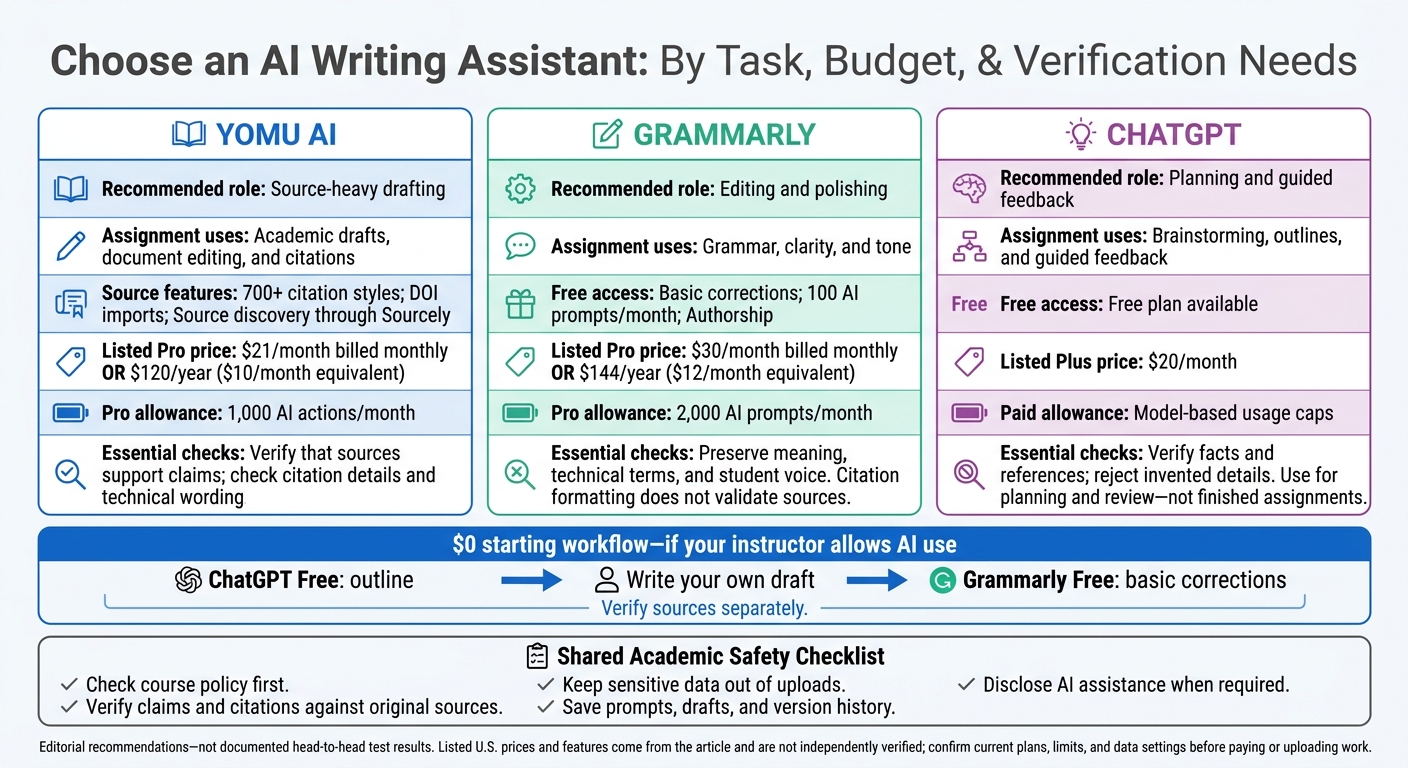
AI Writing Assistants for Students: Which Tool Fits Your Task?
1. Yomu AI
Assignment Drafting
Academise turns rough notes into formal prose, while Tab-key autocomplete helps you keep writing. The trade-off? Output can sound robotic. Use Yomu to guide your drafts, not take them over. Short essays and reflective writing need your editorial judgment; lab reports need manual checks to protect technical meaning.
Revision Accuracy
Get Feedback lets you preview revisions before applying them. Accept edits only if they preserve your argument, attribution, and technical terms. For research summaries, check the methods and findings against the source before using the text.
Source and Citation Reliability
Research papers need sources that support each claim - not just polished citations. Yomu offers 700+ citation styles, DOI imports, and source discovery through Sourcely. Write your claim first, check the paper for supporting evidence, then verify the title, authors, year, and DOI before adding the citation.
Cost and Integrity Notes
Writing quality matters, but price and school policies also shape whether the tool fits student use.
Listed prices are $21/month for Pro with 1,000 AI actions and $35/month for Ultra with unlimited actions. With annual billing, Pro costs about $10–$11/month and Ultra about $17–$18/month. Check the checkout price before committing. Pro may fit light-to-moderate assignment workloads; consider Ultra if you regularly need more than 1,000 actions.
Treat the plagiarism checker as a screening tool, not proof of originality: its coverage is unclear. Don’t upload confidential research or personal data. Follow your institution’s policies, and use Yomu for brainstorming, outlining, and editing rather than one-click generation. Save drafts and version history to document your writing process.
sbb-itb-1831901
2. Grammarly
Grammarly focuses less on drafting and more on cleaning up what you’ve written.
Assignment Drafting
Use Grammarly to polish your argument, not build it. Finish your research and outline before using its AI prompts. Free includes 100 AI prompts per month, while Pro includes 2,000.
On essays, use it after the thesis is fixed; on lab reports, avoid letting it rewrite technical explanations.
Revision Accuracy
Set your goals to Academic and Formal for help with grammar, punctuation, spelling, and clarity. These are surface edits: cleaner sentences won’t make weak paragraphs persuasive. Heavy rewrites can also flatten your voice.
For lab reports, check that rewrites do not change technical terms or measured results. It catches surface issues in introductions and abstracts, not missing evidence or weak logic.
Source and Citation Reliability
Paid plans include citation support and plagiarism checking. Use Grammarly to check citation formatting, not to validate sources.
For research papers, it helps format citations, not verify that a source supports the claim.
Cost and Academic Safeguards
Free costs $0. Pro costs about $12/month with annual billing or $30/month with monthly billing.
Free Authorship records typed, pasted, and AI-assisted text. You decide whether to share the replay. Turn it on when you start writing to keep a record of how you created the assignment.
For an essay, enable Authorship before drafting to document the writing process.
3. ChatGPT
ChatGPT works best for planning, testing angles, and getting a second round of feedback. For essays, research papers, and lab reports, use it to plan and review - not to produce finished assignments.
Assignment Drafting
Before you draft, ask ChatGPT for five thesis options with brief pros and cons. Share your rubric, then request a 1,500-word outline that includes a counterargument.
Repeat the prompt in a separate session and check both versions against every rubric item. This keeps ChatGPT in a planning role rather than a final-draft role.
Revision Accuracy
Ask for feedback on your own passage before requesting a rewrite. Tell ChatGPT to keep your meaning and voice intact. For papers over 3,000 words, review later sections for repetition and shifts in voice.
For lab reports, check every suggested edit against your recorded methods and results. Reject invented details and any interpretation your data doesn’t support.
Source and Citation Reliability
Treat citation suggestions as leads, not evidence. Check that each cited passage supports your claim using citation tool essentials. Even a real paper can be linked to the wrong claim.
Cost and Academic Safeguards
Pricing varies by source, so check U.S. rates before subscribing. Start with the free plan and upgrade only if you need higher usage or upload limits.
Follow your instructor’s AI policy, disclose assistance when required, and save your prompts and drafts. Use Study mode for guided questions - not finished text.
Assignment Results: Essays, Research Papers, and Lab Reports
The differences are clearest when you compare tools by assignment type.
| Task | Yomu AI | Grammarly | ChatGPT |
|---|---|---|---|
| Argumentative essays | Citation-ready first drafts. | Strong on surface edits, weak on building arguments. | Early thesis testing and outlining. |
| Research papers | Built-in support for source-heavy papers. | Polishing and originality checks, not research. | Source discovery with links students need to verify. |
| Lab reports | Turns notes into prose that needs technical review. | Checks formal tone and wording, not whether evidence is valid. | Explains methods and summarizes data, but needs accuracy checks. |
| Editing | Academic feedback students can preview. | Grammar, spelling, and style checks. | Quick proofreading, though the writing voice may shift in longer papers. |
| Price fit | Free chat, with unclear action limits. Billed annually: Pro costs about $10–$11/month for 1,000 actions; Ultra costs about $17–$18/month for unlimited actions. | Free basic checks, 100 monthly AI prompts, and Authorship. Pro costs about $12/month, billed annually. | Free Study mode and limited search. Plus costs about $20/month. |
Research papers show the biggest gap between drafting help and source verification.
Finding sources, formatting citations, and checking claims are separate jobs. Source-discovery tools find leads. Citation tools format references. Students still need to read the original sources and check whether they support the claims in their papers.
For APA, MLA, or Chicago papers, check each reference against the original record before trusting its formatting. The supplied material does not establish an error rate for any tool across these styles.
Next: pricing, privacy, and academic-integrity trade-offs.
U.S. Pricing, Privacy, and Academic Integrity
Check the total cost, not just the advertised monthly rate. These prices reflect provider details verified before publication. Confirm current pricing on each provider’s site before paying. None of these tools offers a separate student plan.
| Tool | Free access | Paid pricing and billing | Usage caps and restrictions |
|---|---|---|---|
| Yomu AI | Free Chat tier; usage limits are not explicitly published. | Pro: $10/month billed annually ($120/year) or $21/month billed monthly. Ultra: $17/month billed annually ($204/year) or $35/month billed monthly. | Pro: 1,000 actions/month. Ultra: unlimited actions. |
| Grammarly | Basic grammar, spelling, and punctuation checks. | Premium starts at $12/month billed annually ($144/year) or $30/month billed monthly. | Usage caps vary by feature. Plagiarism checks require Premium. |
| ChatGPT | Free access to standard models. | Plus: $20/month. | Plus has model-based usage caps. |
Price is only part of the decision. Privacy settings and disclosure rules also matter when choosing a tool for class work.
| Tool | Data use and training | Plagiarism checks | Disclosure support |
|---|---|---|---|
| Yomu AI | Collects account and usage data but does not state a specific retention period. It says user data is not used to train its AI models. | Includes a plagiarism checker, but its database coverage and validation methods are not fully transparent. | Academic Mode offers citation-backed answers. It does not replace a statement explaining your AI use. |
| Grammarly | Uses standard account data retention for service improvement. You can toggle the model-improvement setting in settings. | Premium checks cover web and ProQuest sources. | Tone and style tools do not replace required disclosure. |
| ChatGPT | Retains prompts and outputs unless you opt out or use Team/Enterprise. Personal plans use data for training by default. | The material reviewed does not list a built-in plagiarism checker. | Students must document assistance and handle citations themselves. |
For graded work, course policy comes first. Read the syllabus or ask your instructor before using AI. Rules differ by school, course, and assignment. If disclosure is required, name the tool and explain how you used it. Even the best free academic plagiarism checkers cannot tell you whether your work follows course policy.
AI cannot be listed as an author. Do not submit unedited AI output as your own, and check every claim and citation against the original source.
Keep personal information, confidential research data, and unpublished manuscripts out of uploads. Before uploading sensitive material, review your institution’s rules and the provider’s privacy policy; retention and training details may be unclear.
Final Verdict: Choose by Assignment and Budget
The comparisons of essays, research papers, and lab reports point to a simple rule: choose by assignment type and budget.
| Your main need | Recommendation | Key caveat |
|---|---|---|
| Research papers with PDFs, sources, and drafts to manage | Yomu AI for document-based academic writing. | Check each citation against its source. |
| Revising essays or polishing lab reports | Grammarly for revision and polishing. | Preserve technical terms and your voice. |
| Working through thesis options or testing an argument | ChatGPT for brainstorming, outlining, and spotting argument gaps in study mode. | Treat facts and references as unverified. |
For a $0 workflow, use ChatGPT Free to work through an outline and Grammarly Free for basic corrections. Stick to planning and revision, and verify sources separately.
Pay only for work you do regularly. Choose Yomu Pro if you often write source-heavy papers. Choose a paid Grammarly plan if you regularly need style feedback and plagiarism checks.
Before submitting, check whether AI use is allowed for the task, verify claims and citations, and save your drafts. Keep sensitive information out of uploads, and disclose AI use when required.
FAQs
How can I verify that a source supports my claim?
Check every citation by hand. An AI-generated bibliography doesn’t prove that its sources are accurate. Look up each paper’s DOI or publisher record to confirm it exists, then check its title, authors, and publication year.
Read the relevant section of each source to make sure it supports the exact sentence you’ve cited it for. Even a real source can be unrelated to your point - or contradict your argument.
What should my AI-use disclosure include?
Check your course syllabus or ask your instructor first. AI-use policies can differ by school, department, and assignment. In your disclosure, name the tool you used and explain how it helped with your work.
Save drafts or version history to document your use of the tool. For a formal citation of AI assistance, follow the guidance in citation styles such as APA or MLA.
How can I preserve my voice when using Yomu AI?
Use Yomu AI as a collaborator, not a substitute for your thinking. Define your research question, build your argument, and outline your claims first. Then use AI to suggest transitions, clarify your writing, or expand your notes.
When using autocomplete or Academise, check that the output matches your intent and rewrite it in your own voice. Don’t rely on AI to write entire sections. Keep your thesis and critical analysis at the center of your work.