

AI Thesis Generators: Useful Starting Point or Academic Risk?
AI thesis generators are transforming academic writing by offering AI writing tools to create thesis statements, outlines, and even full drafts. But are they a help or a hazard? Here's what you need to know:
- Benefits: These tools save time, help with writer's block, and assist non-native English speakers. They can even reduce research timelines from months to weeks.
- Risks: AI can fabricate citations, produce shallow arguments, and over-reliance may hinder critical thinking. Universities often view AI-generated work as conflicting with academic integrity.
- Key Players: Tools like Yomu AI, ThesisAI, Scribbr AI, and EssayBot each offer unique features but vary in reliability and academic risks.
- Best Practices: Use AI as a starting point, verify all citations manually, and ensure originality in your work. Treat these tools as assistants, not replacements for intellectual effort.
Quick Comparison:
| Tool | Strengths | Weaknesses | Risk Level |
|---|---|---|---|
| Yomu AI | Plagiarism checker, citation support | Generic text, needs oversight | Low |
| ThesisAI | Fast drafts, structural frameworks | Shallow arguments | Medium |
| Scribbr AI | Editing and feedback focus | Limited discipline-specific nuance | Low-Medium |
| EssayBot | Budget-friendly | Plagiarism risks, unreliable sources | High |
AI thesis generators are helpful but come with caveats. Use them wisely to enhance, not replace, your academic work.
The AI Thesis Writing System That Cuts Your Workload in Half
sbb-itb-1831901
What Are AI Thesis Generators?
AI thesis generators take a research topic or keywords and turn them into a clear, debatable thesis statement. You provide the subject, and the tool evaluates the context, essay style, and argument to create a structured starting point for your paper.
These tools rely on Large Language Models (LLMs), which are trained on massive amounts of text. Some models are further refined using academic datasets to better match the tone and structure required for scholarly work. This advanced training allows them to craft thesis statements more effectively.
Modern generators go a step further by tailoring thesis statements to specific essay formats. Whether the essay is argumentative, analytical, expository, or persuasive, the tool adjusts the thesis structure accordingly. Take Yomu AI as an example - it’s designed for academic writing and offers features like outlining, drafting, paraphrasing, and even citation formatting, making it much more than just a thesis generator.
While traditional literature reviews can take anywhere from 6 to 12 months, AI tools can cut that timeline down to 2–4 weeks. They provide students with a structured draft, helping to overcome the dreaded writer’s block.
However, it’s important to remember that AI-generated thesis statements are meant to be a starting point, not the final product. As Dr. Rebecca Sharma, a PhD thesis evaluator at Stanford, explains:
"The AI produced what I'd characterize as a competent but uninspired early draft from a first-year doctoral student."
1. Yomu AI
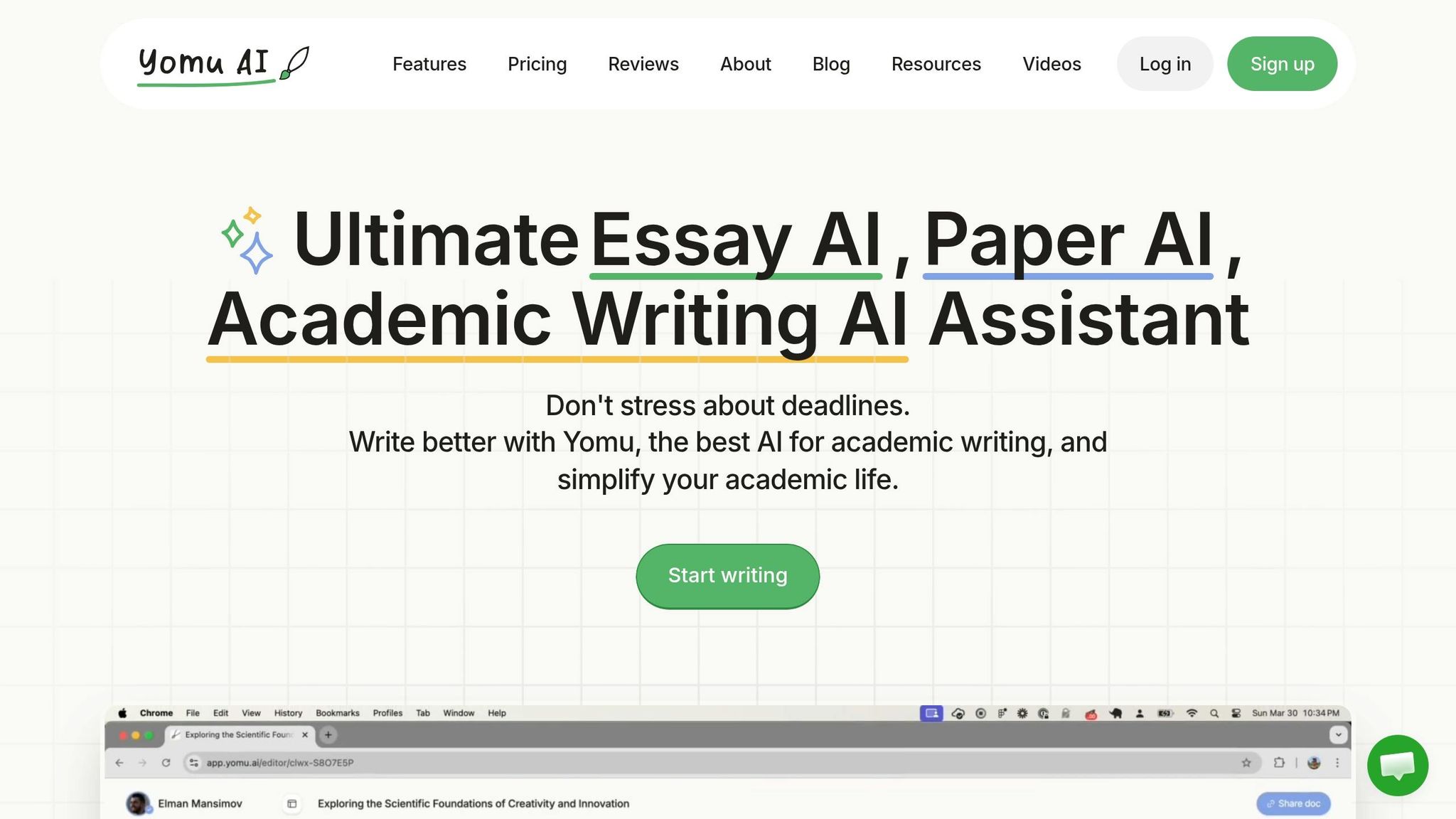
Yomu AI takes academic writing to the next level by combining thesis generation, drafting, editing, citation management, and formatting into a single platform. This means you can handle your entire academic writing process without juggling multiple tools.
Research Integration
With Yomu's Chat AI, you can directly engage with uploaded PDFs, conduct academic and web searches, and quickly summarize lengthy papers . It helps map out major debates, key concepts, and foundational theories within your field while also identifying thematic connections and contradictions across various sources. However, its knowledge cutoff might limit access to the most recent publications. This feature simplifies research, making it easier to build a strong foundation for your work.
Citation Management
Yomu AI includes a citation tool that allows you to highlight a sentence and automatically insert a properly formatted reference. It also helps you build a bibliography, supporting major citation styles like APA and Harvard . That said, you'll need to manually verify citations to ensure they meet academic standards .
"The citation problems alone would make this unacceptable in an academic context... this wouldn't pass muster as a chapter in a defended dissertation without substantial human input and revision." - Dr. Rebecca Sharma, PhD Thesis Evaluator, Stanford University
Outline Generation
The "Ideas" feature is a game-changer for organizing your research. It generates structured outlines with headings and key points tailored to your research question. According to surveys, about 82% of students use AI-generated outlines to manage complex projects, and Yomu AI makes this process efficient while keeping your input central to the final structure .
Plagiarism Detection
To help maintain originality, Yomu AI includes a plagiarism checker for academic papers. It scans your document against online sources, provides a similarity report, and flags any questionable sentences . While this tool is helpful, it should be used as a supplement to your own judgment to avoid academic misconduct.
Pricing (USD)
Yomu AI offers a range of pricing plans to suit different needs, from occasional use to lifetime access.
| Plan | Price (USD) | Key Features |
|---|---|---|
| Starter | $9 (one-time) | 10 AI actions, GPT-4o mini access |
| Pro | $11–$19/mo | Unlimited actions, GPT-5 mini, Claude 4.5 Haiku, Gemini 3.0 Flash |
| Ultra | $18–$29/mo | Access to top-tier models (GPT-5, Claude 4.5 Sonnet & Opus, Gemini 3.0 Pro), custom writing styles |
| Believer | $499 (lifetime) | Unlimited lifetime access to all premium features and models |
The Starter plan is ideal for occasional users or first-time testers, while the Pro plan offers excellent value for regular academic tasks. For those looking to invest in long-term use, the Believer plan provides lifetime access. Additionally, promotional codes like EFFORTLESS20 (20% off monthly) and EFFORTLESS40 (40% off yearly) can help you save.
2. ThesisAI
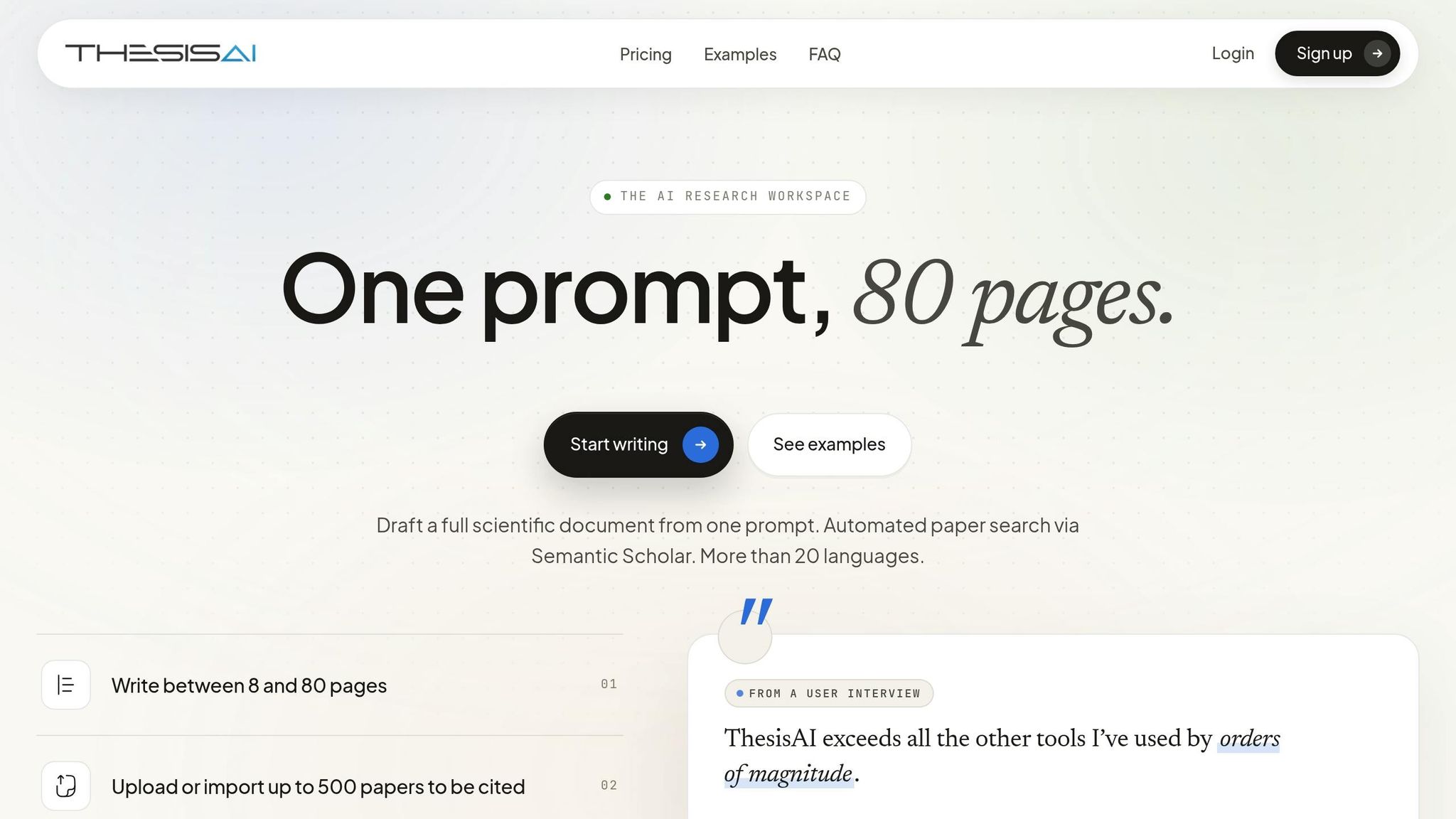
ThesisAI is designed to create academic documents efficiently, producing everything from an Abstract to a Literature Review. With over 100,000 documents generated, the platform averages a 26-minute turnaround for a first draft, spanning anywhere from 8 to 80 pages. Its standout features include seamless integration, precise academic paper citations handling, and well-structured outputs, making it a valuable tool for academic workflows.
Research Integration
ThesisAI connects directly to Semantic Scholar, allowing users to search and retrieve relevant academic papers. It also supports uploading or importing up to 500 papers and integrates smoothly with Zotero for managing references.
Citation Management
ThesisAI excels in citation accuracy, boasting a 94% accuracy rate, with every citation verified against its source material. It supports multiple citation styles, including APA, IEEE, Harvard, Oxford, Chicago, and numeric/alphabetic formats. Users can export citations in BibTeX format or send their documents directly to Overleaf for LaTeX editing.
"ThesisAI exceeds all the other tools I've used by orders of magnitude." - Gary Styger, CEng MIMechE · M-Phil
Outline Generation
The platform automatically generates a comprehensive document structure tailored to the research question, streamlining the writing process.
Plagiarism Detection
Instead of using a traditional academic plagiarism detector, the Pro plan offers a Citation Report that evaluates sentences and classifies claims as "Fully supported", "Academic synthesis", "Not supported", or "Contradictory". Additionally, the Pro plan includes low AI-detectability post-processing, helping content pass heuristic AI detectors. However, it’s essential to confirm your institution's stance on AI-generated content before using this feature.
"Pro outputs are post-processed so they pass common AI-detection tools as human-written. This is intended for legitimate academic use where your reviewers run heuristic detectors that flag false positives." - ThesisAI
Pricing (USD)
ThesisAI offers tiered subscription plans, with discounts for students using verified university emails (20% off) and savings of 50% for annual billing compared to monthly rates.
| Feature | Basic Plan | Pro Plan |
|---|---|---|
| Monthly Price (Annual Billing) | $11.00 | $14.00 |
| Monthly Price (Monthly Billing) | $22.00 | $28.00 |
| Max Pages per Document | 50 | 80 |
| Citation Report | No | Yes |
| AI-Detectability | Standard | Low (Post-processed) |
| Export Formats | PDF, LaTeX, BibTeX | PDF, LaTeX, BibTeX, Word |
| Source Capacity | Up to 500 papers | Up to 500 papers |
Both plans include up to 48 documents per year, with options to scale for higher output needs.
3. Scribbr AI
Scribbr is different from tools that generate essays or theses. Instead of creating content, it focuses on improving and refining your work. It positions itself as a platform dedicated to academic integrity, blending automated tools with optional human expert reviews. This strong emphasis on quality makes Scribbr a standout choice for students aiming to uphold scholarly standards.
Research Integration
Scribbr supports students with a rich library of over 300 articles, videos, and how-to guides on topics like methodology, statistics, and dissertation structure. These resources attract around 5 million users each month. However, Scribbr doesn’t function as a research tool - it doesn’t connect to academic databases or retrieve papers directly.
Citation Management
Scribbr’s free Citation Generator simplifies referencing in APA, MLA, Chicago, and Harvard styles. By pulling metadata from sources like URLs, DOIs, ISBNs, or article titles, it reduces manual errors. The tool is built using the open-source Citation Style Language (CSL). For more thorough checks, a Citation Checker add-on is available for $10–$15.
Additionally, Scribbr provides resources to help with document structure, making it easier for students to format their work effectively.
Outline Generation
For students needing help with organization, Scribbr offers downloadable templates for Word and Google Docs. Its Structure Check tool reviews paragraph logic and flow, offering feedback on drafts. While it doesn’t generate full outlines, it’s a helpful option for those who already have a draft and want to refine it.
Plagiarism Detection
Scribbr’s plagiarism detection is a standout feature. Powered by Turnitin technology, it scans over 99 billion web pages and 8 million academic publications. Its AI detector can identify about 94% of AI-generated content with a false positive rate of 9%. Importantly, Scribbr does not store uploaded documents in a shared repository, so students don’t have to worry about self-plagiarism issues when submitting to their institutions.
"Scribbr uses advanced plagiarism detection technology similar to the software used by most universities and publishers." - Scribbr
It’s always a good idea to manually review flagged sections to ensure accuracy.
Pricing (USD)
Scribbr operates on a pay-per-use model, which can be economical for one-time submissions but may feel costly for frequent users.
| Document Size | Price (USD) | What's Included |
|---|---|---|
| Up to 7,500 words | $19.95 | Plagiarism report + AI Proofreader |
| 7,500–50,000 words | $29.95 | Plagiarism report + AI Proofreader |
| 50,000+ words | $39.95 | Plagiarism report + AI Proofreader |
| Human Proofreading | ~$100 per 4,100 words | Expert review, clarity, and style alignment |
| AI Detector | Free | Up to 1,200 words per scan |
The free AI detector and Citation Generator are useful tools to explore before committing to any paid services. Scribbr has earned a 4.7/5 rating from 15,537 Trustpilot reviews. Users often praise its citation accuracy and human editing quality, though the pay-per-document model is a common concern for those needing ongoing feedback.
4. EssayBot
EssayBot is designed to generate essay content by pulling from a scholastic database, offering a quick way to create written material without much user input. While it can be a time-saver, it also raises serious concerns about academic integrity. Aaron Yin, the tool's creator, describes it as a "research tool" and a "shortcut", not a platform for cheating. Interestingly, EssayBot began as a tool for creating branding copy and résumés for small businesses before shifting its focus to students.
Research Integration
When you input a topic, EssayBot generates an introductory paragraph based on its academic database. However, its ability to build coherent arguments is limited. The content often feels fragmented, and the quality tends to drop after about 150 words because of its reliance on sequential word generation.
Citation Management
EssayBot includes a feature to match references and format citations, aiming to produce submission-ready drafts. However, its citation capabilities are far from reliable. Users are strongly encouraged to double-check references using tools like Google Scholar and to manually verify every source for accuracy.
Outline Generation
The platform also offers a way to structure essays by adding additional paragraphs or generating follow-up sentences. While this can help overcome writer's block, the resulting outlines often lack logical flow and coherence. These structural issues, combined with its sourcing and plagiarism concerns, highlight the risks of using EssayBot for academic work.
Plagiarism Detection
One of the biggest criticisms of EssayBot is its approach to plagiarism. Instead of traditional plagiarism detection, it uses a rephrasing algorithm to replace certain words with synonyms, helping it bypass plagiarism checkers.
"Your opening paragraph is pulled whole cloth from a database of scholastic material. Then the diction is gently rephrased... until it can fly under the radar of the average plagiarism detection tools." - Luke Winkie, Journalist, Vox
Even if a paper passes a plagiarism scan, it may not meet academic standards. For instance, Mr. Lourey, a 10th-grade history teacher, reviewed an EssayBot-generated paper on Brown v. Board of Education. His assessment was clear:
"Even if I did not identify the paper as a creation of AI, it would earn a failing grade." - Mr. Lourey, 10th-grade History Teacher
Pricing (USD)
| Plan | Price |
|---|---|
| Monthly Subscription | $9.95/month |
| Annual Subscription | $49.95/year |
EssayBot's pricing is budget-friendly, with a monthly plan under $10 and an annual option for less than $50. However, the low cost comes at a significant risk. The platform's reliance on rephrasing and its academic limitations make it a risky choice for students. Many universities consider AI-generated essays a form of academic dishonesty, and using EssayBot could lead to serious consequences.
Pros and Cons of Each Tool
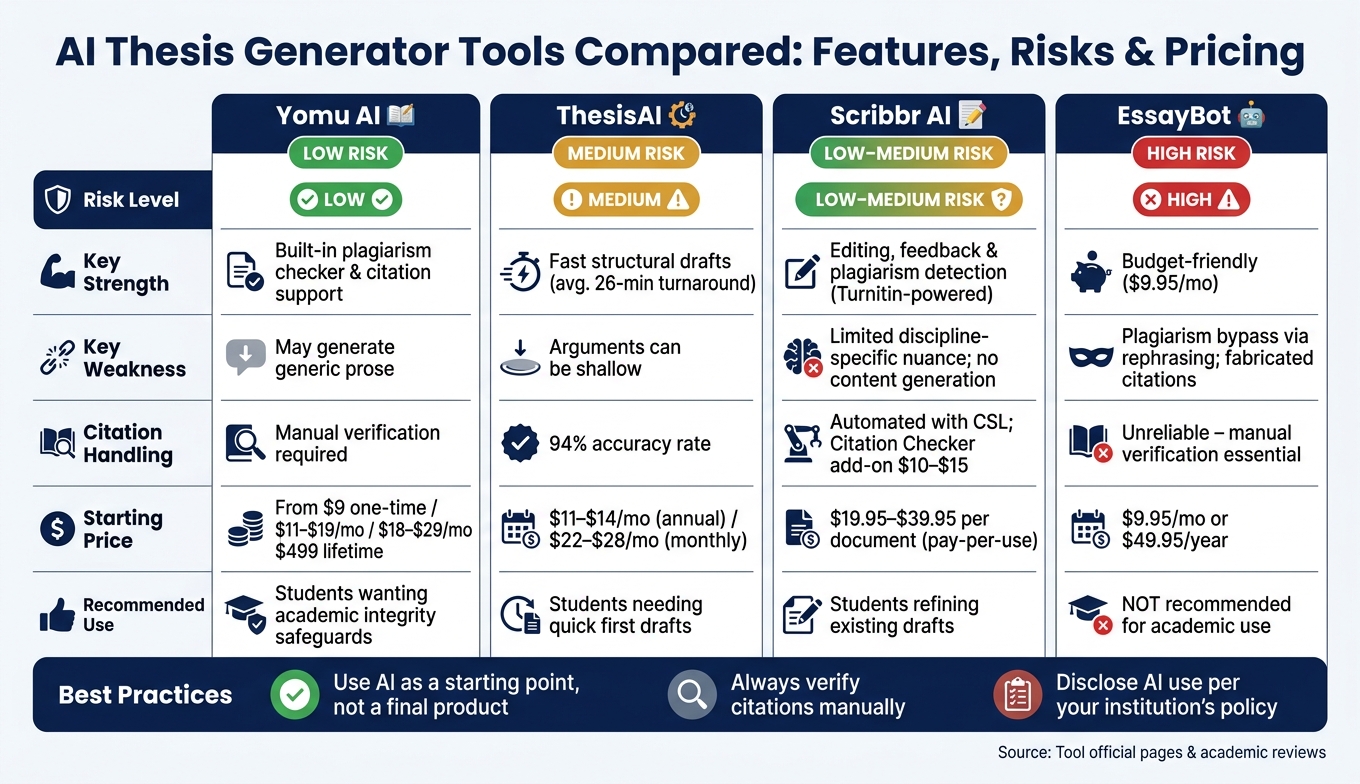
AI Thesis Generator Tools Compared: Features, Risks & Pricing
Each tool brings its own strengths and challenges to the table when it comes to academic thesis generation. Here's a closer look at their key advantages and drawbacks.
Yomu AI stands out for prioritizing academic integrity with its built-in plagiarism checker and citation support. This makes it a safer choice for students who want assistance while ensuring their work remains original. However, like many AI tools, it sometimes generates generic text, which may dilute a student's unique scholarly voice.
ThesisAI shines in helping students tackle the dreaded "blank page" by overcoming writer's block by quickly generating structural frameworks and thesis drafts. That said, because it relies heavily on statistical patterns, the arguments it produces can feel shallow or lack depth.
Scribbr AI focuses more on refining and offering feedback rather than creating drafts from scratch. This approach reduces some risks tied to academic integrity. However, it may struggle to address the specific nuances of certain academic disciplines. On the flip side, tools with fewer safeguards against misuse pose a greater risk to academic standards.
EssayBot, however, carries the highest academic risk. Its rephrasing capabilities can enable students to bypass plagiarism detection, and its issues with sourcing often result in fabricated or misattributed references. A 2024 study highlighted how large language models occasionally invent citations or incorrectly attribute them.
"The blind use of unverified AI text shows a lack of creativity, originality, independent reasoning, and intellectual depth." - Elizabeth Oommen George, Paperpal
| Tool | Key Strength | Key Limitation | Risk Level |
|---|---|---|---|
| Yomu AI | Built-in plagiarism checker and citation support | May generate generic prose, requiring oversight to preserve originality | Low |
| ThesisAI | Quickly generates structural drafts | Arguments can be superficial, lacking depth | Medium |
| Scribbr AI | Focuses on editing and feedback | May not fully address discipline-specific nuances | Low–Medium |
| EssayBot | - | Enables plagiarism bypass; prone to fabricated or misattributed citations | High |
These insights highlight the importance of using AI tools responsibly. Always cross-check citations with reliable databases to ensure accuracy and maintain academic standards.
Conclusion
AI thesis generators serve as helpful tools in academic writing, but their role is limited. Take Yomu AI, for instance - it includes features like a built-in plagiarism checker and citation support. However, many other tools require careful monitoring to ensure academic integrity. This underscores a key point: AI should complement, not replace, the critical thinking and originality required in academic work.
The main takeaway? Think of AI as a research assistant, not a ghostwriter. It's great for organizing outlines, drafting sections on widely understood topics, or simplifying complex language. But the heart of academic writing - like identifying research gaps, crafting unique arguments, and evaluating sources - remains firmly in your hands.
"AI writing assistants are becoming increasingly sophisticated, but they are no substitute for human intellect and originality in academic writing." - Randall Altman, Author
For students, the rule is straightforward: verify citations manually, disclose AI use when required, and treat AI-generated drafts as starting points, not final products. Educators, too, have a role to play. A 2026 study involving 934 participants revealed that institutions with clear AI policies saw noticeable improvements in perceived thesis quality (B = 0.118, p < .001). Clear guidelines matter.
As noted earlier, responsible AI use is essential for maintaining academic integrity. Universities are already adapting - AI-detection tools are becoming more common, and academic policies are evolving to address AI's role in writing. The real winners are students who use these tools to refine their ideas, not replace their own intellectual effort.
FAQs
Is using an AI thesis generator considered cheating?
Using an AI thesis generator without proper acknowledgment can cross into academic misconduct, especially if you present the AI-generated work as entirely your own. To stay on the right side of ethics, it's crucial to be upfront about using AI tools, carefully review and verify their output, and ensure the final work represents your personal ideas and analysis. Skipping these steps or depending solely on AI not only compromises academic integrity but could also result in severe repercussions.
How can I tell if an AI-made citation is fake?
You can spot fake AI-generated citations by cross-referencing them with trustworthy platforms such as Google Scholar, PubMed, or CrossRef. Look out for red flags like nonexistent DOIs, made-up journal names, or incorrect author information. Taking the time to verify ensures both accuracy and credibility.
What parts of a thesis should I never outsource to AI?
You should never rely on AI to handle your original ideas, analysis, or conclusions. These aspects are essential for upholding academic integrity, presenting your unique perspective, and ensuring your work remains genuinely your own.