

AI Humanizers and Academic Writing: What Students Should Know Before Using One
AI humanizers refine AI-generated text to make it sound more natural and human-like. These tools restructure sentences, adjust tone, and improve flow, helping students avoid detection by AI-detection tools like Turnitin. With universities increasingly flagging AI-assisted work (67% use detection tools, 41% investigate flagged cases), humanizers can be helpful, especially for non-native English speakers who are often unfairly flagged. However, ethical concerns arise when these tools are misused to disguise AI content as original work.
Key Points:
- What They Do: AI humanizers focus on improving tone, sentence structure, and rhythm in AI-generated content.
- Why They Matter: Academic institutions are cracking down on AI use, and detection tools are becoming more accurate (90% by 2025).
- Risks: Over-reliance on these tools can lead to ethical violations and hinder personal growth in writing.
- Best Use: Use humanizers for fine-tuning and clarity, but ensure your ideas and voice remain central. Always check institutional policies on AI tool usage.
AI humanizers can save time and reduce stress, but they should be used responsibly to maintain academic integrity.
#5 Humanizing AI Text for Academic Papers (No Tools Needed!)
sbb-itb-1831901
The Problem: Common Writing Struggles and AI Detection Risks
Writing can be a daunting task for many students. From grappling with writer's block to maintaining a consistent tone, the challenges are real. It's no wonder that in a global survey conducted in mid-2024, 86% of students admitted to using AI tools for schoolwork. These tools offer a lifeline, helping students brainstorm ideas, create outlines, and draft sections that might otherwise take days to complete.
However, while these tools can boost creativity, they also come with a significant risk: detection. AI-generated text often carries identifiable patterns. Systems like Turnitin analyze features such as word predictability and sentence structure to flag content as AI-generated. By mid-2024, Turnitin had already scanned over 200 million student papers using its AI detection technology. And as these systems evolve, their ability to spot AI-generated work improves.
The consequences of being flagged can be severe. If your work is identified as AI-assisted, you could face accusations of academic dishonesty, which can harm your reputation and academic record. As Annie Chechitelli, Turnitin's Chief Product Officer, explained:
"The system is a probabilistic tool, not a definitive judge."
Adding to the complexity is the pressure to adopt a highly "academic" tone. In trying to sound formal, students often fall into a trap of overusing generic transitions like "Furthermore" and "Moreover." Ironically, this effort to sound polished can make the writing appear robotic - exactly the kind of pattern AI detectors are designed to catch. Over-editing can strip away the natural quirks and inconsistencies that signal human authorship, inadvertently increasing the likelihood of detection.
This creates a frustrating paradox: the more students try to perfect their writing, the more it can resemble AI-generated text. These challenges highlight the importance of tools and strategies that balance clarity with a genuine human touch.
How AI Humanizers Work
At their core, AI humanizers rely on natural language processing (NLP) and machine learning (ML) to transform text, making it feel less mechanical and more natural. This involves reworking sentence structures and fine-tuning tone. As Elizabeth Oommen George from Paperpal explains:
"AI humanizers primarily focus on reframing existing text. Their goal is to reduce 'machine-like signals' in written language to help authors avoid high scores for AI-generated writing."
The process hinges on addressing two key linguistic markers that AI detectors evaluate: perplexity and burstiness. Perplexity refers to how predictable word choices are - AI tends to pick the statistically most likely words, creating a flat and formulaic tone. Burstiness, on the other hand, measures sentence length variation. Human writing naturally alternates between short, impactful sentences and longer, more intricate ones. AI, however, often produces sentences of similar lengths. Humanizers are trained specifically to break these patterns.
What sets humanizers apart from basic paraphrasing tools is the depth of their rewriting. While paraphrasers operate at the word or phrase level, humanizers work on a broader scale - reorganizing ideas, varying the rhythm of paragraphs, and replacing generic transitions like "Furthermore" with more contextually relevant alternatives. The difference is striking. For example, in tests, raw AI-generated abstracts flagged at 88–97% by AI detectors dropped to just 5–18% after being processed by advanced humanizers.
When it comes to academic writing, humanizers face even greater challenges. Advanced tools incorporate an "Academic Mode" that carefully preserves critical elements such as technical terms, citation brackets, and statistical data (e.g., p < 0.01), while refining the surrounding text . Without this safeguard, errors can creep in - like converting "2024" into "twenty-twenty-four" or diluting precise data into vague language, potentially leading to inaccuracies and triggering manual reviews.
Here's a quick comparison of key metrics between raw AI output and humanized text:
| Metric | AI-Generated Pattern | Humanized Pattern |
|---|---|---|
| Perplexity | Low - predictable word choices | High - unexpected, varied vocabulary |
| Burstiness | Low - uniform sentence lengths | High - mix of short and long sentences |
| Structure | Symmetrical and balanced | Irregular and rhythmic |
| Transitions | Over-reliance on "Furthermore" | Direct movement with varied signposting |
Yomu AI's Humanization Features
Yomu AI takes the concept of AI humanization and applies it directly to academic writing, offering tools that make AI-generated content feel more natural and authentic.
Instead of simply swapping out words or phrases, Yomu AI tackles the deeper issue of repetitive and robotic patterns in text. For example, it replaces overused filler phrases like "It is important to note" with more concise, impactful alternatives. The result is writing that flows more like human prose, with a rhythm that feels natural to the reader.
A standout feature is its few-shot learning capability. This allows users to input 2–3 paragraphs of their own writing, which the AI then analyzes to mimic their personal style. During paraphrasing, Yomu AI retains the user's unique voice, ensuring the output feels like a true extension of their work. Users can also fine-tune parameters such as sentence length, vocabulary complexity, and the use of cautious language (e.g., words like "suggests" or "may") to align with the conventions of their academic discipline. This customization not only reduces the risk of detection but also meets the exacting standards of scholarly writing.
Daniel Felix, a Yomu AI author, outlines the hallmarks of academic style:
"Academic Style Characteristics: Evidence-based argumentation, precise terminology, cautious language and qualifiers, third-person perspective, formal tone and structure, and citation integration."
Yomu AI also shines when it comes to citations. Powered by Sourcely and linked to 14 academic databases in real time, its citation engine handles 43 styles with a single click. It achieves impressive accuracy rates: 97.8% for APA 7th edition and 98.2% for MLA 9th edition, while keeping citation errors (or "hallucinations") to just 0.3% - far better than the industry norm. To put this into perspective, students often spend 6–8 hours formatting citations for a single term paper without AI assistance.
These tools integrate smoothly into academic workflows, combining features like a plagiarism checker and PDF metadata extraction. Together, they create an efficient, all-in-one platform for academic writing.
Benefits and Limitations of AI Humanizers in Academic Writing
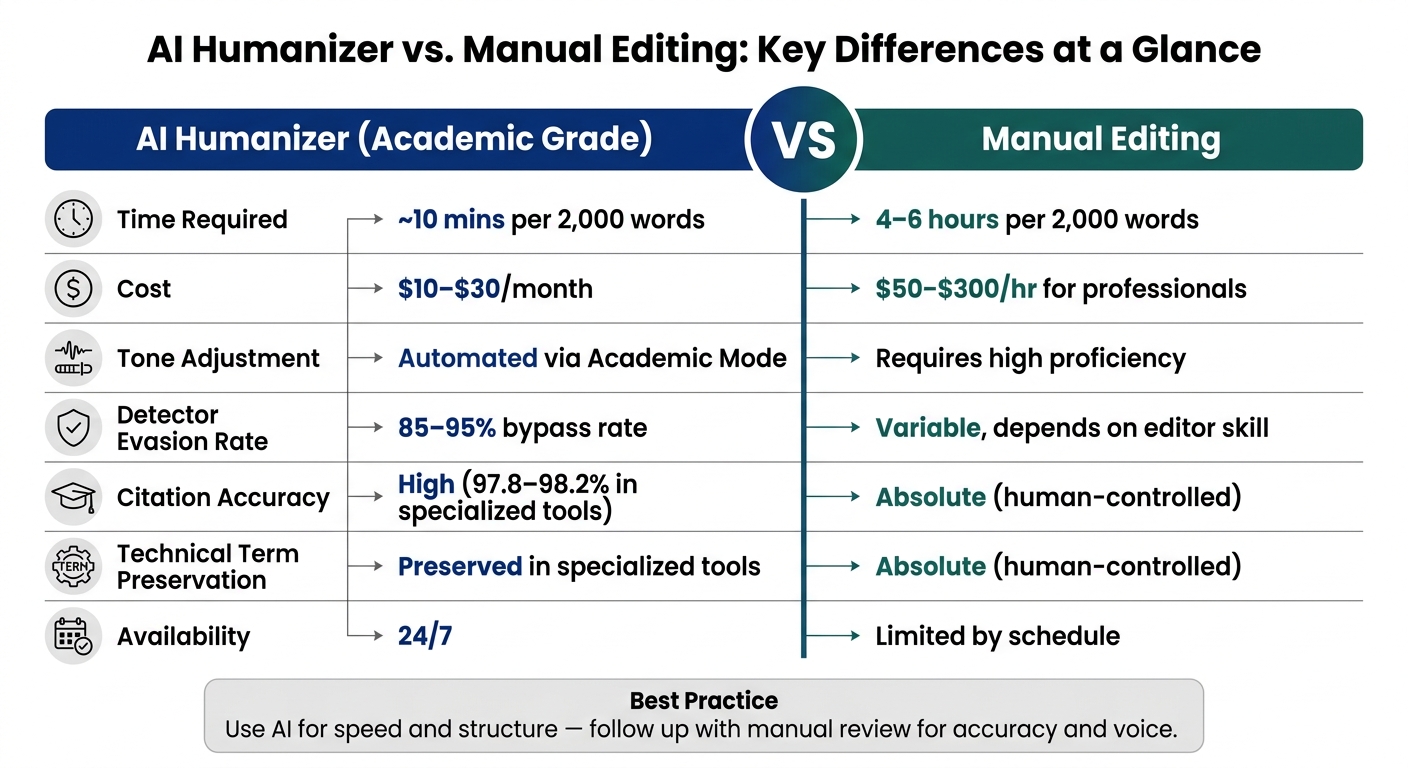
AI Humanizer vs. Manual Editing: Speed, Cost & Accuracy Compared
Benefits of Using AI Humanizers
Time is often a scarce resource, especially for students juggling multiple assignments and deadlines. An AI humanizer like Yomu AI can transform a 2,000-word section in just 10 minutes, compared to the 4–6 hours it would take to do the same task manually. That’s a game-changer for anyone looking to save hours on revisions.
These tools are also a lifeline for multilingual students. Writing in a second language can be a slow and stressful process. Studies show that multilingual students typically spend 2.5 to 3 times longer on writing tasks than native speakers. For example, a study involving 45 international STEM graduate students found that AI writing assistants reduced language-related stress by 62%, cut writing time by 47%, and improved the overall quality of their documents by 38%.
"AI writing tools are rapidly becoming essential equity instruments, helping level a playing field that has historically disadvantaged non-native English speakers." - Dr. Elena Yamaguchi, Director of the International Writing Center, University of Michigan
Beyond saving time and easing stress, academic-grade humanizers improve the natural flow of writing. They can vary sentence structure, replace repetitive transitions, and refine the overall tone, making arguments sound more polished while maintaining a scholarly voice. These refinements not only make the writing process faster but also help reduce the chances of being flagged by AI-detection tools, as the output feels more organic.
While these tools offer undeniable advantages, it’s important to weigh their limitations carefully.
Limitations to Keep in Mind
AI humanizers aren’t perfect. Generic tools can sometimes weaken your arguments, remove important qualifiers, or even misrepresent technical details. For instance, they might rewrite "p < 0.05" as "p was less than 0.05", which could lead to confusion or inaccuracies in academic contexts.
Another concern is the ethical gray area. Using AI humanizers to present AI-generated content as entirely your own could violate academic integrity policies. Over-reliance on these tools might also hinder your ability to develop critical thinking and refine your own academic voice, both of which are crucial for long-term success.
Some institutions are addressing these concerns by promoting transparency. Instead of outright banning AI tools, they encourage students to disclose their use, making honesty a more sustainable practice in academic settings.
Comparison Table: AI Humanizers vs. Manual Editing
Here’s a side-by-side look at how AI humanizers stack up against manual editing across key factors:
| Feature | AI Humanizer (Academic Grade) | Manual Editing |
|---|---|---|
| Time Required | ~10 mins per 2,000 words | 4–6 hours per 2,000 words |
| Cost | Low ($10–$30/month) | High ($50–$300/hr for professionals) |
| Tone Adjustment | Automated (Academic Mode) | Manual (requires high proficiency) |
| Detector Evasion | High (85–95% bypass rate) | Variable (depends on editor's skill) |
| Citation Accuracy | High (in specialized tools) | Absolute (human-controlled) |
| Technical Terms | Preserved (in specialized tools) | Absolute (human-controlled) |
| Availability | 24/7 | Limited by schedule |
This table highlights the strengths and weaknesses of each approach. AI humanizers shine when it comes to speed, cost, and accessibility. However, manual editing remains unmatched for accuracy and maintaining authenticity. A balanced approach works best - use AI for quick structural improvements and technical tweaks, then follow up with a manual review to ensure accuracy and inject your personal academic style.
Ethical Guidelines and Best Practices for Using AI Humanizers
The increasing reliance on AI writing assistants, especially among students, highlights why it's so important to approach AI humanizers responsibly. As academic institutions tighten oversight, ethical use of these tools becomes essential - not just for compliance but for preserving the integrity of your work.
AI humanizers can improve your writing by refining tone and clarity, but they should never replace your own ideas. Using them to disguise AI-generated content as entirely original is a clear ethical violation.
"Using AI content humanizers to deliberately mask AI authorship is seen as cheating and dishonest, even if it helps you pass initial AI detection checks." - Elizabeth Oommen George
Before incorporating AI tools into your academic work, make sure to check your syllabus or consult your instructor. Policies vary widely: while some professors have strict rules, institutions like Harvard and Oxford emphasize transparency by requiring students to disclose AI assistance rather than banning it outright.
To use AI humanizers ethically while protecting academic integrity, consider these steps:
- Develop your core arguments independently. Let your ideas take center stage before turning to AI tools.
- Use AI humanizers for fine-tuning. Focus on improving tone, flow, and readability - not generating content.
- Personalize and review. Edit the final product to ensure it reflects your unique perspective and voice.
If you're ever flagged for AI use, maintaining a record of your drafts and revisions can demonstrate your original contributions.
"If you'd feel uncomfortable telling your advisor exactly how you used AI tools, reconsider your process." - ProofreaderPro.ai
Conclusion: Using AI Humanizers the Right Way in Academic Writing
AI humanizers can be a game-changer for academic writing - when used with care. A global survey from mid-2024 revealed that 86% of students already incorporate AI tools into their schoolwork. This makes understanding how to use these tools responsibly more critical than ever.
Think of tools like Yomu AI as a style editor, not a ghostwriter. Your ideas and research should always take center stage, with the tool serving to refine how you communicate them.
The cornerstone of any AI-assisted process is manual personalization. After generating a draft, revisit it to infuse your own voice and insights. Keeping records of your drafts can also help demonstrate your original contributions. Striking the right balance between efficiency and originality is essential. And don’t forget - transparency is non-negotiable. Clearly disclosing your use of AI tools protects your academic integrity and ensures trust in your work.
FAQs
Will a humanizer change my meaning or data?
A humanizer doesn’t change the essence of your message or the facts you present. Instead, it polishes the text to make it feel more natural and conversational, improving the rhythm, tone, and readability while keeping your original ideas intact.
How can I use a humanizer without breaking my school’s rules?
To use a humanizer responsibly, make sure it serves as a tool to refine your original writing rather than generating or heavily modifying content. Start by drafting your work manually, then use the tool to polish elements like tone and flow. If your school or institution requires it, be upfront about any AI assistance. Finally, carefully review the finished text to ensure it aligns with your voice and upholds academic integrity.
What should I save as proof the work is mine?
To establish that your work is genuinely yours, consider saving drafts, keeping editing records, or using tools designed to track revisions. These methods provide evidence of your authorship and show the progression of your writing process.