

Reading and Writing: Shared Neural Networks
Reading and writing activate overlapping brain regions, making them deeply interconnected. Research shows that practicing one skill strengthens the other, as both rely on shared neural networks for processing letters, sounds, and meanings. Key brain areas like the left fusiform gyrus (critical for recognizing and producing written words) and Exner's area (linked to handwriting) highlight this connection. For example:
- Shared Brain Activity: The same neurons in the fusiform gyrus light up during both reading and writing tasks.
- Handwriting Benefits: Handwriting, more than typing, boosts letter recognition and reading comprehension in young learners.
- Language Processing: Pathways like the arcuate fasciculus bridge sound interpretation and speech production, supporting literacy across languages.
Early language exposure and integrated teaching strategies (combining reading and writing) enhance these neural pathways, improving literacy outcomes. Tools like Yomu AI leverage this connection by simplifying writing tasks, enabling users to focus on ideas while reinforcing their reading and writing skills.
Neural Networks Used in Both Reading and Writing
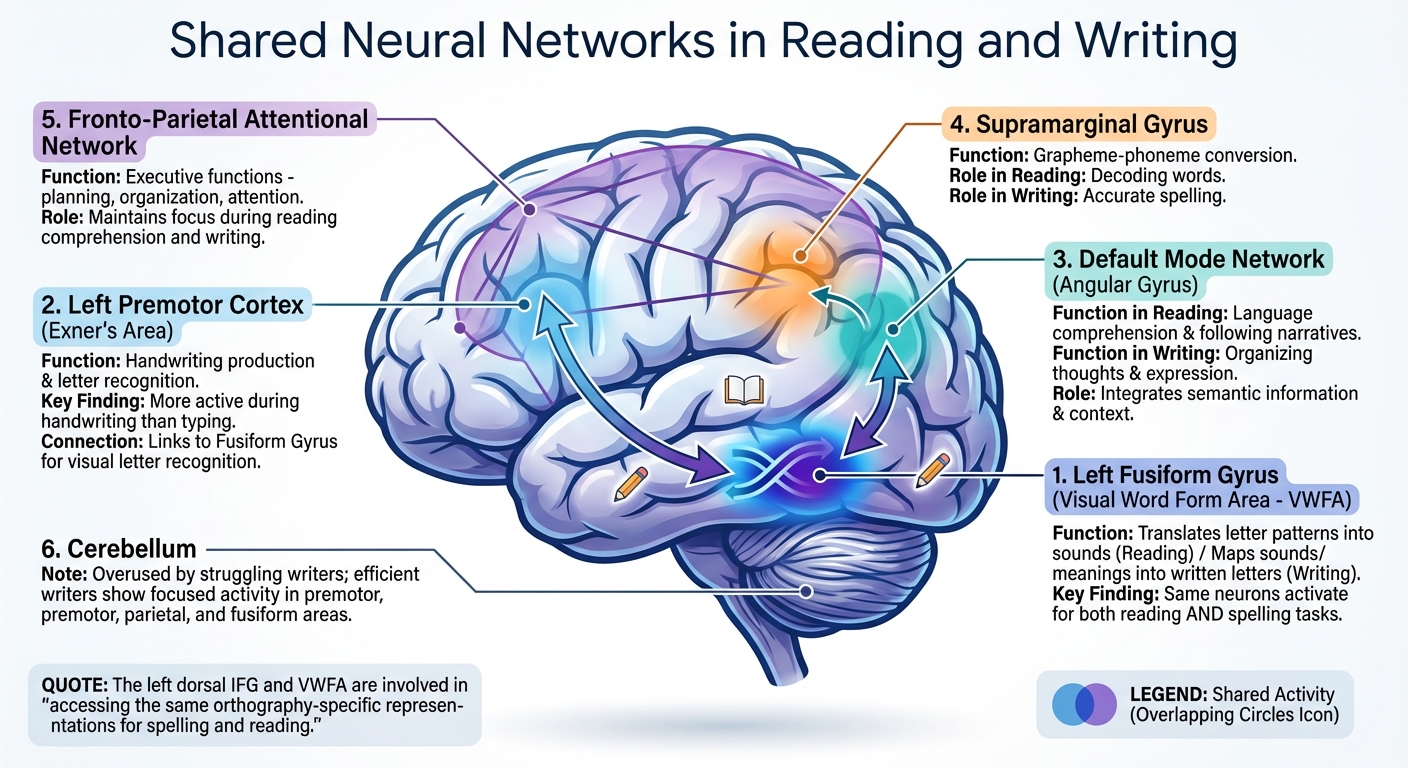
Shared Neural Networks in Reading and Writing: Brain Regions and Their Functions
Expanding on the shared mechanisms of reading and writing, let's dive into the neural networks that support both activities. The brain relies on overlapping systems, creating a unified framework for literacy. Understanding these networks helps explain how practicing one skill - reading or writing - can directly strengthen the other.
The Left Fusiform Gyrus: Bridging Visual and Phonological Information
The left fusiform gyrus, particularly the Visual Word Form Area (VWFA), acts as a critical hub for both reading and writing. This region translates letter patterns into sounds while reading and performs the reverse - mapping sounds or meanings into written letters - when writing. Fascinatingly, fMRI-Adaptation studies show that the same neurons in this area light up whether you're reading a word or spelling it.
"The left dorsal IFG and VWFA are involved in accessing the same orthography‐specific representations for spelling and reading".
A striking example of this connection comes from a 2010 case study published in the Journal of Cognitive Neuroscience. A patient with a surgical lesion in the left mid-fusiform gyrus experienced difficulties in both reading and spelling, yet their ability to recognize faces, objects, and spoken words remained intact. Additionally, functional MRI studies reveal that this region's role in text processing develops with education - it becomes active in literate adults but remains dormant in those who have never learned to read.
The Default Mode Network and Language Comprehension
The Default Mode Network (DMN), which includes the angular gyrus, is essential for making sense of language. This network helps integrate semantic information and understand context, whether you're following a narrative while reading or organizing your thoughts for writing. It plays a key role in connecting ideas and deriving meaning from language, supporting both comprehension and expression.
Frontal and Parietal Regions: Planning and Control
The frontal and parietal regions are the brain's command centers for the executive functions needed in reading and writing. These areas handle planning, organization, attention, and goal-oriented behavior. For example, the supramarginal gyrus in the parietal lobe is crucial for grapheme-phoneme conversion - essential for decoding words while reading and spelling them accurately. Meanwhile, the fronto-parietal attentional network ensures focus, whether you're tackling a dense paragraph or crafting a well-structured sentence. Together, these regions orchestrate how we process and produce written language, highlighting their shared role in literacy.
What This Means for Literacy Development and Education
The connection between reading and writing in the brain offers a clear roadmap for improving literacy education. By teaching these skills together, educators can strengthen the shared neural pathways that support both. This approach encourages teaching strategies that combine reading and writing to maximize their mutual benefits.
Building Literacy Skills by Teaching Reading and Writing Together
Studies consistently show that combining reading and writing instruction yields better results than teaching them separately. For instance, a meta-analysis of 47 literacy programs revealed that balanced curricula - where reading and writing instruction each accounted for no more than 60% of the time - led to improvements in both areas. When students engage in both encoding (writing) and decoding (reading), they activate overlapping neural regions, such as the left fusiform gyrus and premotor areas, reinforcing their skills.
"Reading and writing instruction appear to be effective when combined." - Stephen Sawchuk, Assistant Managing Editor, Education Week
Handwriting, in particular, plays a key role in early literacy. Unlike typing, handwriting activates Exner's area in the left premotor cortex, which is also involved in recognizing letters visually. This activation strengthens letter recognition and enhances both reading and writing abilities.
Writing also deepens comprehension by reinforcing background knowledge. A meta-analysis of nearly 60 studies found that "writing to learn" activities - like summarizing science concepts or analyzing historical events - help students absorb material more thoroughly, improving their understanding when they encounter similar content in reading.
Efficient writers show focused activity in brain regions like the premotor, parietal, and fusiform areas, while struggling writers overuse auxiliary regions like the cerebellum. Teaching writing mechanics, such as sentence and paragraph construction, can help students achieve automaticity. This frees up mental energy for more complex thinking and comprehension. Even before formal schooling begins, early language experiences play a critical role in shaping these interconnected brain networks.
How Early Language Exposure Shapes Brain Development
Literacy development starts well before children enter a classroom. Early language exposure helps shape the white matter tracts that connect the brain's visual, auditory, and language-processing regions. Research highlights the importance of caregiver speech, showing a strong correlation (0.88) between the quality and quantity of language exposure and the efficiency of these neural pathways.
Early literacy skills, such as word reading and spelling, are also closely linked (0.96 correlation). Additionally, vocabulary mastery accounts for 58% of the variance in later academic performance, emphasizing the value of rich language environments.
"We need to be thinking about reading and writing reciprocally." - Dana Robertson, Associate Professor of Reading and Literacy, Virginia Tech
Early intervention is vital because brain development is highly influenced by experience. Processes like myelination, which speeds up signal transmission, and pruning, which removes unused neural connections, are shaped by the language input children receive. Activities like prewriting can predict future skills in decoding, spelling, and reading comprehension. By integrating reading and writing from the outset, educators can help children build strong, interconnected neural networks that support literacy throughout their lives.
sbb-itb-1831901
How Yomu AI Supports Academic Writing and Literacy

Research in neuroscience reveals a fascinating link: reading and writing share neural pathways. Yomu AI taps into this connection by managing the technical aspects of writing - like sentence structure and formatting - so users can focus their mental energy on developing ideas. By integrating these features, the platform strengthens the natural bond between reading and writing, ultimately boosting literacy skills.
AI-Powered Writing Assistance
Yomu AI takes these neural insights a step further by automating the mechanics of writing. With tools powered by generative AI, the platform offers features like sentence and paragraph autocomplete, paraphrasing, and summarization. These tools are designed to help students overcome writer's block and polish their academic writing. By handling the technical side, Yomu AI reduces the mental strain of writing, allowing users to concentrate on their ideas. Additionally, the "Ask AI" feature simplifies the process of extracting key information from lengthy research papers, making it easier to engage with academic texts and respond thoughtfully. This back-and-forth interaction between reading and writing strengthens literacy skills over time.
Upholding Academic Integrity
Originality and proper attribution are cornerstones of academic writing. Yomu AI supports these principles with a built-in plagiarism checker to ensure originality and accurate citations. It also streamlines the often tedious task of formatting references, offering automated support for academic paper citations like APA and MLA. By simplifying these technical requirements, Yomu AI helps students stay focused on their ideas while reinforcing the ethical practices essential to academic writing. This approach nurtures both skill development and integrity, supporting literacy through a deeper understanding of writing standards.
Streamlining Research and Document Organization
Good academic writing relies on clear and logical organization. Yomu AI provides a centralized workspace for managing research and drafts, making it easier to structure ideas from brainstorming to final formatting. This organizational support is invaluable for tasks that require analytical thinking and deep learning. As Dana Robertson from Virginia Tech explains:
"The writing tasks that we're asking students to do in response to texts have to [align] with the purpose of learning".
Conclusion: Connecting Reading and Writing Through the Brain
Key Takeaways
The brain doesn’t come pre-equipped with a specific center for reading. Instead, it creatively repurposes existing neural circuits through its remarkable adaptability. Reading and writing share a common graphomotor network, which includes the left premotor cortex, the fusiform gyrus, the superior parietal cortex, and the cerebellum. Because these skills rely on the same neural wiring, improving one naturally strengthens the other. For example, handwriting practice helps solidify visual letter recognition in the fusiform gyrus, and quick handwriting ability has been shown to correlate with better reading scores in young learners.
This understanding shifts how we think about teaching literacy. Instead of treating reading and writing as separate disciplines, combining them in instruction helps students connect sounds to letters more effectively. This integrated approach creates stronger neural pathways, leading to better literacy outcomes overall.
How Technology Supports Literacy
These insights into the brain’s functioning also highlight how modern technology can play a role in literacy development by providing writing tips and tricks for digital environments. Today’s tools are designed to support the natural connection between reading and writing by automating technical tasks, allowing students to focus on their ideas. For instance, AI-powered platforms simplify citation management and formatting, so users can dedicate their energy to understanding source material and crafting thoughtful responses. When these tools align with how the brain processes language, they enhance both writing (encoding) and reading (decoding), reinforcing literacy skills over time.
However, balance is key. Research shows that handwriting activates motor-visual networks more strongly than typing. Yet, digital tools excel in helping students organize research, ensure originality, and manage citations. The most effective use of technology is when it complements - rather than replaces - the brain’s natural pathways for learning. By blending traditional methods like handwriting with modern tech, we can create a more holistic approach to literacy development, one that leverages both the brain’s structure and the tools of the digital age.
FAQs
How are reading and writing connected in the brain?
Reading and writing are closely connected in the brain, relying on shared neural networks that play a key role in literacy development. Studies reveal that certain brain regions are involved in both recognizing written words and performing the act of writing. This creates a feedback loop - writing strengthens the pathways needed for reading, and reading, in turn, enhances the brain’s ability to process written language.
One of the critical areas involved is the visual word form area (VWFA), which evolves as we learn to read and write. Practicing these skills not only improves literacy but also makes the brain more efficient at handling language - both visually and through motor functions. This interconnectedness underscores why engaging in both reading and writing is essential for developing strong language skills.
How does handwriting help improve literacy skills compared to typing?
Handwriting is essential for developing literacy because it engages neural networks tied to visual-motor integration. This connection helps bridge reading and writing skills, both of which are crucial for early literacy growth.
Beyond that, handwriting aids in refining motor skills, which in turn boost memory and enhance cognitive processing. These advantages highlight why handwriting remains such an important part of establishing a solid literacy foundation.
How does combining reading and writing instruction improve literacy skills?
Combining reading and writing instruction builds stronger literacy skills by tapping into the natural relationship between these two processes. Studies highlight that teaching them together boosts vocabulary, planning abilities, comprehension, and writing quality - especially for younger learners. Programs that blend reading, writing, and oral language also encourage students to produce clearer, better-organized texts.
This method works because reading and writing complement each other. When taught side by side, they promote critical thinking, encourage the use of strategies, and refine editing skills. Simultaneously addressing these areas improves fluency and fosters deeper understanding, laying a solid foundation for long-term academic growth.