

Persuasive Essay Topics That Are Not Overused
Choosing a persuasive essay topic that hasn't been overdone can make your writing stand out, engage your audience, and encourage deeper discussions. This article highlights underexplored subjects across various areas like AI ethics, environmental issues, social media, workplace evolution, health innovation, and education reform. Here's a quick overview of some unique ideas:
- AI Ethics: Should AI systems make life-or-death decisions in healthcare? Who is responsible when autonomous AI causes harm - developers, users, or governments?
- Modern Environmental Issues: Should tech companies disclose the water footprint of AI services? Can circular economy models help reduce fast fashion waste?
- Social Media: Should parents face restrictions on sharing their children’s lives online? Is social media prioritizing visibility over expertise?
- Workplace Evolution: Should companies pay equal tax rates for human workers and automated systems? Does AI-driven automation create a "purpose crisis" for workers?
- Health Innovation: Should genetic editing for lifestyle changes be considered ethically different from traditional parenting? Do wearable health devices shift responsibility from healthcare providers to individuals?
- Education Reform: Should financial literacy replace advanced mathematics as a core requirement? Should schools adopt four-day weeks to improve student well-being?
These topics are timely, thought-provoking, and can lead to meaningful essays. Avoiding overused debates ensures your arguments feel fresh and relevant, sparking genuine interest from your audience.
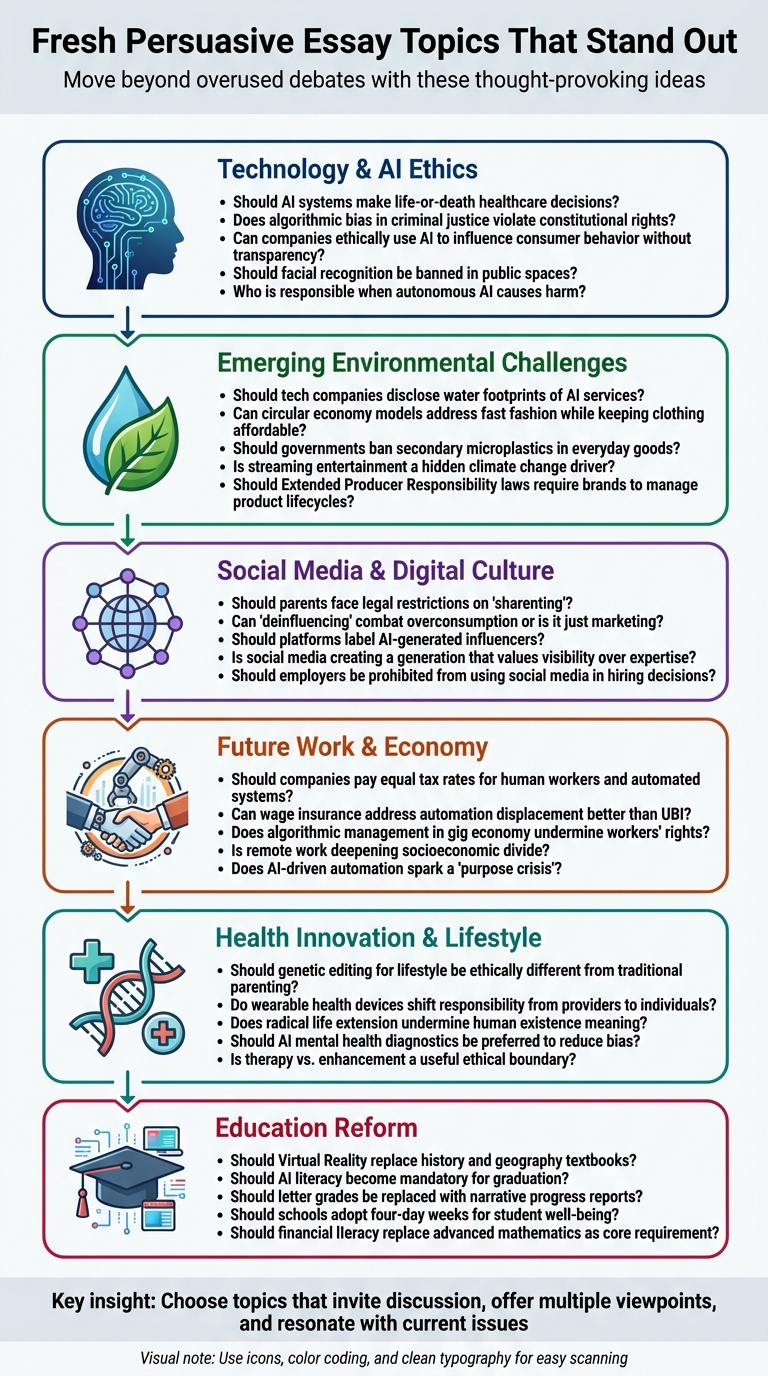
50+ Fresh Persuasive Essay Topics Across 6 Key Categories
101 Persuasive Essay Topic Ideas | Essay Writing
sbb-itb-1831901
1. Technology and AI Ethics
Should AI systems make life-or-death decisions in healthcare? This question highlights a tough balance between efficiency and accountability. When algorithms decide who gets treatment, the "black box" problem comes into play - developers themselves often can't explain how decisions are made. This raises serious concerns about patient rights and trust in medical systems. It's a dilemma that echoes issues seen in other industries.
Does algorithmic bias in criminal justice violate constitutional rights? A 2016 ProPublica investigation uncovered troubling disparities in the COMPAS algorithm. For example, Brisha Borden, a Black woman caught stealing a child’s bicycle, was labeled high-risk for reoffending. Meanwhile, Vernon Prater, a white man convicted of armed robbery, was rated low-risk. The outcome? Borden never reoffended, but Prater did. This case exposes how AI can reinforce racial biases, especially in sentencing and bail decisions.
Can companies ethically use AI to influence consumer behavior without transparency? AI systems often nudge consumers in ways that might undermine personal freedom. One example is Amazon's hiring algorithm from the 2010s, which was scrapped after it showed bias against women - largely because it had been trained on resumes from a male-dominated industry. Such cases raise questions about whether companies should disclose when AI shapes decisions that affect people’s lives.
Should facial recognition technology be banned in public spaces? Evidence shows these systems often fail when identifying people of color. For instance, one AI model misclassified nearly 50% of Black female faces. These inaccuracies lead to serious risks, like wrongful arrests and surveillance abuses. This sparks an ongoing debate about whether privacy should take precedence over security.
Is the "right to an explanation" for automated decisions realistic? The EU’s GDPR grants citizens the ability to demand explanations for decisions made by algorithms. However, the complexity of modern AI makes this challenging. This raises a bigger question: can legal protections keep up with technology? And when algorithms determine access to housing, credit, or jobs, what does accountability look like?
Who is responsible when autonomous AI causes harm - developers, users, or governments? Justin Biddle, Director of Georgia Tech's Ethics, Technology, and Human Interaction Center, offers a key insight:
"AI systems are value-laden because they're human creations".
As AI takes on more critical roles, figuring out who bears responsibility for its mistakes becomes essential - especially when those mistakes can have lifelong consequences for individuals.
2. Emerging Environmental Challenges
Tackling these modern environmental dilemmas can inspire thought-provoking essay ideas that push beyond traditional discussions.
Should tech companies be required to disclose the water footprint of AI services?
Cooling data centers consumes about 2 liters of water per kilowatt-hour, and the global AI infrastructure could soon demand six times Denmark's annual water supply. Each ChatGPT query and training cluster uses significantly more energy than standard workloads, with electricity consumption projected to hit 1,050 terawatt-hours by 2026. Sally Radwan, Chief Digital Officer at the United Nations Environment Programme, highlights the urgency of this issue:
"We need to make sure the net effect of AI on the planet is positive before we deploy the technology at scale".
This raises questions about the role of transparency and accountability in managing AI's environmental impact.
Can circular economy models address the fast fashion crisis while keeping clothing affordable?
The environmental toll of fast fashion is staggering - up to 10% of global greenhouse gas emissions come from the industry, which also generates 17 million tons of textile waste annually. Circular economy practices offer some hope. For instance, Suay Sew Shop in Los Angeles has repurposed over 4 million pounds of discarded textiles, and Petit Pli’s innovative designs allow clothing to grow through seven sizes over nine years. These examples show that reducing waste doesn’t have to hurt profitability. As Barchi Gillai from Stanford Graduate School of Business puts it:
"Slowing down the rate of production doesn't have to come at the expense of profitability".
Should governments ban secondary microplastics in everyday goods like tires and textiles?
Textiles contribute 35% of all microplastics entering the ocean, largely through fibers shed during laundry. A single load of laundry can release between 640,000 and 1.5 million plastic microfibers. On top of that, vehicle tires release toxic chemicals like 6PPD-quinone, which have been linked to salmon die-offs. While microfiber filters can reduce microplastic emissions by nearly 80%, they aren’t mandatory. With global plastic treaty negotiations collapsing in 2025, regulatory efforts have shifted to local governments, leading to a patchwork of policies. This fragmented approach invites deeper discussion on how to tackle the problem effectively.
Is streaming entertainment a hidden driver of climate change?
Streaming services generate over 300 million tons of CO₂ annually, contributing to the tech sector’s 7% share of global emissions. Meanwhile, producing a single smartphone requires 12,760 liters of water, and only 17.4% of the 347 million tons of e-waste is recycled. The short lifespan of digital devices exacerbates the issue, creating hazardous waste filled with materials like mercury and lead, while driving up energy demands.
Can bioengineered textiles replace traditional fabrics without becoming too expensive?
Scientists are turning to organisms like algae, bacteria, yeast, and fungi to create biodegradable fabrics that decompose into non-toxic substances. For example, Bananatex, made from abacá banana plants, has been used by brands like Balenciaga and Stella McCartney. However, cost remains a barrier - bacterial-dyed silk can cost $139 per scarf compared to $10 for conventional fabric. Suzanne Lee, founder of Biofabricate, stresses the importance of innovation in materials:
"If fast fashion is to persist, the materials that are used must begin to be able to be cycled back into the raw material textile streams that feed that segment of fashion".
Should Extended Producer Responsibility laws require brands to manage their products' entire lifecycle?
States like Oregon, Colorado, and California are now making manufacturers responsible for recycling packaging and addressing microplastics. While these laws could reshape product design, they also raise concerns about costs, particularly for small businesses. This evolving policy landscape opens up debates on balancing environmental responsibility with economic feasibility.
3. Social Media and Digital Culture
Beyond debates about technology and the environment, the ever-evolving digital world presents fascinating issues worth exploring. These modern dilemmas offer fresh perspectives that go beyond the usual discussions, especially as new online behaviors emerge.
Should parents face legal restrictions on "sharenting" their children's lives online?
"Sharenting" - the act of parents sharing details and photos of their kids online - creates lasting digital footprints before children can even voice their consent. This raises a tricky question: should laws step in to protect minors from having their personal lives documented and made searchable without their approval? It’s a debate that touches on privacy, autonomy, and the long-term implications of growing up in a digital-first world.
Can "deinfluencing" combat overconsumption, or is it just another marketing tactic?
The rise of "deinfluencing", where creators urge followers to avoid certain products, has sparked curiosity about its authenticity. In 2023, the Australian Competition and Consumer Commission revealed that 81% of influencers failed to properly disclose paid sponsorships. This raises a critical question: can influencers who thrive on promoting consumption genuinely encourage frugality, or is this just a clever rebranding of marketing strategies?
Should social media platforms be required to label AI-generated influencers?
The growing presence of CGI influencers on social media introduces a new layer of complexity. These virtual personas, with their flawless appearances, have been tied to issues like "Snapchat dysmorphia", where users pursue cosmetic changes to match digital ideals. Without clear labeling, it becomes harder to differentiate between real and artificial personas, potentially deepening body image concerns and distorting perceptions of reality.
Is social media creating a generation that values visibility over expertise?
Influencer culture has shifted the spotlight from traditional expertise to visibility and emotional appeal. As Ufuk Özden from Gümüşhane University explains:
"Influencer culture is not merely an individual career choice but also a new form of social representation that internalizes the emotional, ethical, and ideological effects of neoliberal digital culture."
This shift raises concerns about whether young people are prioritizing skills for digital fame over academic and professional growth. It also complicates how social influence shapes economic and cultural accountability.
Should employers and banks be prohibited from using social media in credit scoring and hiring decisions?
Some employers and financial institutions are now factoring online behavior into credit scoring and hiring practices. Known as social credit scoring, this method raises serious concerns about fairness and potential discrimination, especially since the criteria used to evaluate online activity are often unclear.
Can "finstas" and ephemeral content address social media's authenticity crisis?
The rise of private "finstas" and temporary content like Stories shows users carving out spaces for more genuine expression. These platforms allow people to share unfiltered moments, offering a refreshing alternative to the polished, curated images often associated with public profiles. This trend suggests a growing desire for authenticity in an increasingly performative digital landscape.
4. Future Work and Economy
As automation and digitalization continue to reshape society, they bring fresh perspectives for persuasive essays. The workplace is evolving far beyond the home-versus-office debate, challenging traditional ideas about labor, automation, and economic balance.
Should companies pay equal tax rates for human workers and automated systems? Current federal tax codes often incentivize automation - not necessarily for improved efficiency but for tax savings. When businesses face lower tax burdens for using machines instead of human labor, they may replace workers for financial reasons, not performance. This raises critical questions: Should tax policies remain neutral between human and machine labor, or should they actively protect jobs? Exploring this issue opens the door to discussions about wage protection, digital oversight, and the future roles of workers in an automated economy.
Can wage insurance address automation displacement more effectively than universal basic income? Wage insurance offers to cover part of the pay gap when displaced workers take lower-paying jobs, encouraging quicker re-employment. Beyond financial relief, it preserves the psychological and social benefits of work. This invites a comparison with universal basic income (UBI), which, while more expansive, could cost as much as 11% of GDP. Essays could analyze whether targeted solutions like wage insurance offer a more feasible path forward.
Does the gig economy’s "algorithmic management" undermine workers' rights? Gig platforms rely on algorithms to assign tasks, monitor performance, and even deactivate workers - all without human oversight. A 2023 Texas survey of 127 platform workers found their median wage after expenses was just $5.12 per hour - 30% below the federal minimum wage. Meanwhile, companies like Uber reported a net income of $9.8 billion in 2024. This disparity raises tough questions: Do workers deserve more transparency in how algorithms determine their pay and employment status? Should there be stricter regulations to protect their rights?
Is remote work deepening the socioeconomic divide? While 40% of American workers can work remotely, the remaining 60% must be physically present on-site. This divide affects everything from wage growth to workplace dynamics. As MIT economist David Autor aptly puts it:
"The future's not just a prediction exercise, it's a design exercise."
Essays can explore how this growing gap might reshape economic opportunities and social equity.
Should workers receive "universal basic wealth" instead of income payments? An alternative to UBI, this concept proposes giving citizens ownership stakes - such as stocks or bonds - at birth, ensuring they benefit from the automated economy's success. Rather than redistributing income later, this approach empowers individuals to share in the gains of technological progress from the outset.
Does AI-driven automation spark a "purpose crisis"? Jobs provide more than income - they offer identity, status, and a sense of contribution to society. OpenAI CEO Sam Altman has said:
"Jobs are definitely going to go away, full stop."
Even if automation leads to material abundance, what happens to a society where meaningful work disappears? Essays could delve into whether this shift might lead to psychological struggles or even political instability.
5. Health Innovation and Lifestyle
Advances in medical technology are moving at a pace that often outstrips our ability to grapple with the ethical questions they raise. From genetic editing to AI-driven diagnostics, these developments challenge long-standing healthcare norms and invite fresh perspectives. Below are some thought-provoking essay topics that delve into emerging issues in health innovation, offering a break from the usual debates and extending the conversation beyond just technology and the environment.
Should using genetic editing for lifestyle enhancements be considered ethically different from traditional parenting methods?
Parents have always influenced their children's futures - through education, values, and even nutrition. So why does genetic editing feel like a different kind of intervention? Philosopher Michael Sandel suggests that:
"to acknowledge the giftedness of life is to recognize that our talents and powers are not wholly our own doing, nor even fully ours".
On the other hand, ethicist Julian Savulescu argues:
"biological manipulation embodies the human spirit - the capacity to improve ourselves on the basis of reason and judgment".
This debate explores the tension between viewing children as "gifts" versus actively shaping their abilities. It becomes even more complex when considering that many enhancement technologies will likely begin as medical therapies but may later be used "off-label" by healthy individuals.
Do wearable health devices create genuine personal responsibility or just shift the burden from healthcare providers to individuals?
The wearable technology market has exploded, growing from US$15.4 billion in 2020 to US$71.91 billion in 2023. Shipments are expected to reach 644.5 million units by 2027. Research involving 5,391 participants found that wearable trackers significantly boost physical activity levels. Yet, about half of users stop using them within six months. Sociologist Deborah Lupton notes that self-tracking ethics often align with societal ideals of being:
"responsibilised, self-managing and entrepreneurial citizens".
This raises questions about whether these devices empower individuals to take charge of their health or simply create new pressures for constant self-monitoring.
Does radical life extension undermine the meaning of human existence?
Medical breakthroughs like curing heart disease could add seven years to the average U.S. lifespan, while eliminating cancer might add three. Yet some researchers imagine technologies that could extend life by centuries. Critics worry that such longevity might fragment life into "a series of disjointed, meaningless lives", while supporters envision opportunities for tackling long-term goals that are impossible within an 80-year lifespan. This debate touches on profound questions about purpose, legacy, and whether mortality gives life its urgency.
Should AI mental health diagnostics be preferred over human practitioners to reduce bias?
AI offers the potential to diagnose based solely on symptoms and genetic data, bypassing human biases that often lead to underdiagnosis - such as autism in women. Through "digital phenotyping", AI can even predict mental health relapses by monitoring behaviors like typing speed, sleep patterns, and call frequency. While this could improve diagnostic accuracy, it also raises concerns about whether removing human judgment diminishes the therapeutic relationship that many patients value.
Is the distinction between "therapy" and "enhancement" a useful ethical boundary?
"Species-typical functioning" is often used to define what’s considered normal, with interventions aimed at restoring this baseline classified as "therapy", while those exceeding it are labeled "enhancement". But this distinction becomes blurry when looking at history. For example, life expectancy during the Stone Age was just 20–34 years, compared to today’s steady increase of 2.5 years per decade over the past 150 years. At what point does extending life or improving human abilities cross the line from restoration to transformation?
Does social pressure make enhancement technologies a false choice?
In the 2008 Summer Olympics, nearly all medal-winning swimmers wore the Speedo LZR Racer full-body swimsuit, which was so effective that 23 out of 25 world records were broken. The suit was later banned by FINA to maintain the principle that swimming should rely on physical ability rather than technological aids. Similarly, genetic editing might not feel like a true choice if social pressure compels people to adopt it to stay competitive in fields like sports, education, or even parenting. Essays could explore whether enhancement technologies, once available, become less of a choice and more of a necessity for staying relevant.
6. Education Reform
Students today are growing up in a digital-first world, yet many classrooms still rely on outdated teaching methods. Marc Prensky put it best:
"today's students are no longer the people our educational system was designed to teach".
This disconnect sparks debates about how to reshape education to better serve modern learners. Here are five key questions challenging traditional practices.
Should Virtual Reality replace history and geography textbooks?
Imagine standing in Independence Hall during the signing of the Constitution or wandering the Galapagos Islands - all without leaving your classroom. Virtual Reality (VR) has the potential to revolutionize education by turning passive learning into active, immersive experiences. But is it worth the investment, especially when tuition costs are already high? This debate weighs the value of experiential learning against the financial and logistical hurdles.
Should AI literacy become a mandatory graduation requirement?
With 95% of American teenagers owning smartphones, AI tools like ChatGPT are becoming impossible to ignore. Instead of banning them, some argue they should be embraced as essential skills. Brian Green, Director of the Markkula Center for Applied Ethics, made an apt comparison:
"We know calculators exist. But we still teach math".
Should understanding AI become as fundamental as learning algebra or a new language?
Should letter grades be replaced with narrative progress reports?
The traditional A–F grading system often fosters competition rather than collaboration. An alternative is competency-based education, which focuses on skill mastery and uses narrative feedback to track progress. Could this shift create a more supportive and personalized learning environment?.
Should schools adopt four-day weeks to improve student well-being?
Teenagers are notoriously sleep-deprived, with 90% not getting enough rest and 28% falling asleep in class. A four-day school week could alleviate burnout and give students more time to recharge. However, it also raises logistical concerns for parents who work full-time. Interestingly, research shows that later school start times can boost math scores by 2 percentile points and reading scores by 1 point.
Should financial literacy replace advanced mathematics as a core requirement?
How often do adults use calculus compared to budgeting or filing taxes? Financial literacy teaches practical skills like managing debt and understanding taxes - skills that directly impact daily life. This debate questions whether theoretical math courses truly prepare students for the financial realities they’ll face.
Conclusion
Choosing a compelling persuasive essay topic lays the groundwork for a strong argument. As Daniel Felix puts it:
"The right topic not only helps you articulate your point of view effectively but also keeps your audience engaged and invested in what you have to say".
When you tackle fresh subjects like AI ethics or the idea of a four-day school week, you push yourself to think deeply and avoid rehashing overused arguments. This process not only sharpens your critical thinking but also fuels your enthusiasm to craft persuasive, engaging prose.
Even the most brilliant ideas need fine-tuning to truly shine. Tools like Yomu AI can assist in catching errors, refining structure, and strengthening your thesis - helping you polish your work without losing your personal voice.
The topics explored here, from AI ethics to forward-thinking education reforms, provide fertile ground for meaningful debate. They encourage diverse perspectives, are supported by solid research, and resonate with current issues. Ensure your topic invites discussion and allows for multiple viewpoints. With the right topic, you can confidently create writing that sparks thought and drives meaningful conversations.
FAQs
How can I choose a topic that isn’t overused?
To steer clear of overdone subjects, aim for topics that are both fresh and engaging. Delve into niche or less-explored areas, such as unusual societal trends or creative concepts, to grab attention. You could also tackle timely issues, debates, or subjects that resonate with your personal interests to add a unique angle. Make sure to research thoroughly to ensure your topic has substance and isn’t too vague. Most importantly, pick something you genuinely care about - your enthusiasm will shine through and make your essay stand out.
How can I narrow a big topic into a clear thesis?
To refine a broad topic into a clear thesis, zero in on a specific, engaging, and debatable aspect of the subject. Choose a narrower element that can be thoroughly addressed, then create a concise thesis statement that clearly outlines your stance. This method keeps your argument focused and gives your essay a clear sense of purpose.
What sources work best for these newer issues?
When tackling newer, more complex issues in persuasive essays, your best bet is to turn to recent, reputable publications that focus on current societal debates and emerging trends. These sources often offer curated lists of essay ideas backed by expert opinions, thorough research, and discussions on policy. Platforms that cover topics like technology, ethics, and social justice are particularly useful, as they ensure your arguments stay informed and tied to relevant, ongoing conversations.