

150 Persuasive Essay Topics for College Students
Looking for persuasive essay topics that resonate with today’s challenges? This guide offers 150 thought-provoking ideas across key areas like education, technology, health, social issues, politics, and business. These topics are designed to help you craft arguments that spark discussion and critical thinking.
Here’s a quick overview of some key categories and sample topics:
- Education: Should college athletes be paid? Is student loan forgiveness a solution to economic stability?
- Technology: Should social media companies be held accountable for algorithmic harm? Can AI replace human teachers?
- Environment: Should single-use plastics be banned by 2030? Are plant-based diets the key to reducing carbon emissions?
- Health: Should mental health days be mandatory for students? Is taxing junk food an effective way to combat obesity?
- Social Issues: Should the death penalty be abolished? Is cancel culture a threat to free speech?
- Politics: Should the Electoral College be eliminated? Is universal basic income a solution to automation-driven job loss?
- Ethics: Should gene editing like CRISPR be used to prevent diseases? Are unpaid internships ethical?
- Business: Should gig workers be classified as employees? Is corporate data collection too invasive?
These topics address current debates and provide opportunities for meaningful arguments. Whether you’re writing about AI in education, the ethics of cancel culture, or climate policy, choosing the right topic is the first step toward a strong essay.
Looking for help? Tools like Yomu AI can assist with brainstorming, editing, and ensuring your essay is polished and well-supported.
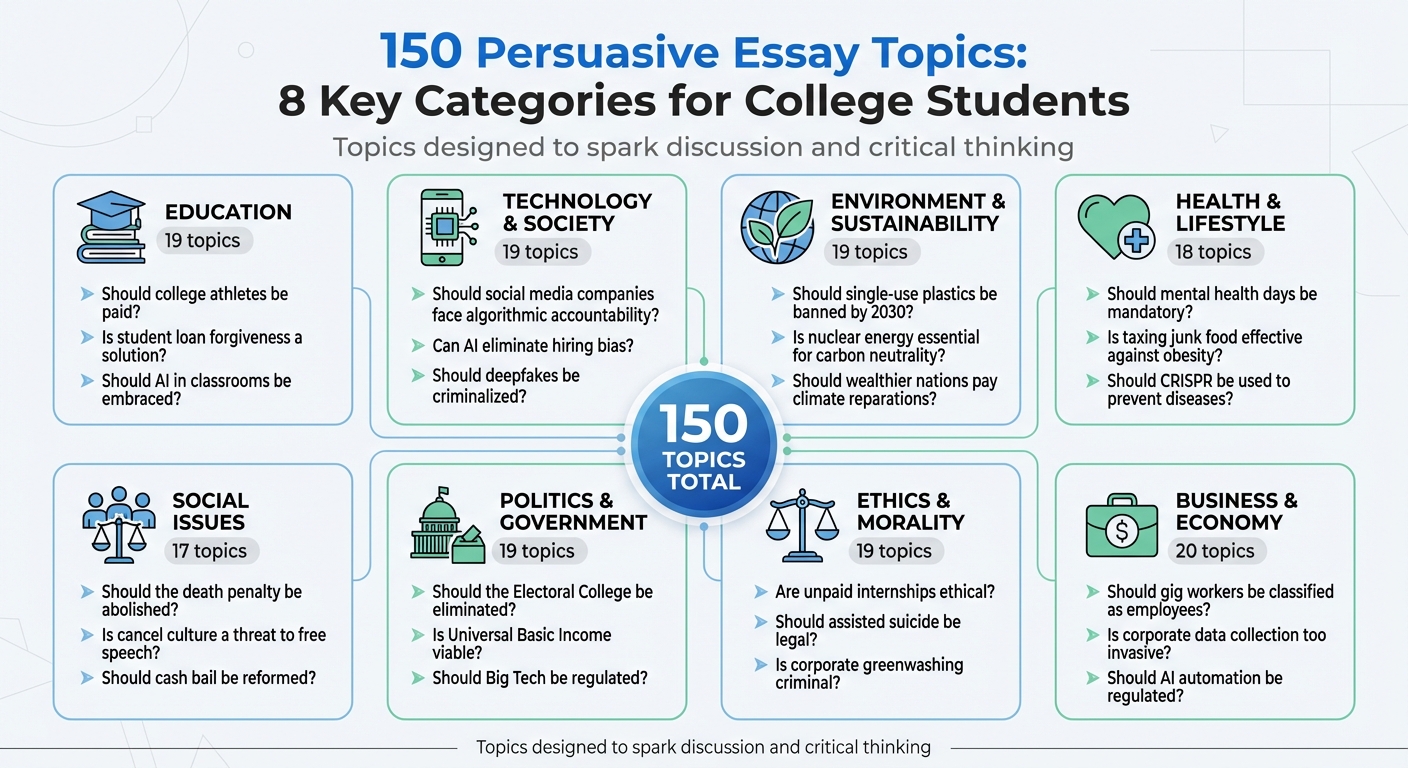
150 Persuasive Essay Topics Across 8 Key Categories for College Students
100 Persuasive Essay Topics For College Students
sbb-itb-1831901
1. Education
Education shapes students' lives, careers, and financial futures, often sparking debates that demand well-reasoned arguments and evidence.
1. Free College Tuition: Should taxpayers fund higher education, making it accessible to all qualified students?
2. Standardized Testing in Admissions: Are SAT and ACT scores still reliable measures of student potential, or have they outlived their purpose?
3. Paying College Athletes: Should college athletes receive compensation for the revenue their sports generate?
4. Student Loan Forgiveness: Can canceling student debt promote long-term economic stability?
5. Mandatory Mental Health Support: Should universities be required to offer free, comprehensive mental health services to every student?
6. Unpaid Internships: Do unpaid internships provide valuable learning experiences, or do they exploit student labor?
7. Attendance Policies: Is mandatory attendance still relevant for adult learners, or should it be reconsidered?
8. Financial Literacy Requirements: Should personal finance courses be mandatory for graduation to better prepare students for real-world financial challenges?
9. AI in the Classroom: Should AI-generated content be embraced as AI writing tools for brainstorming or treated as academic dishonesty?
10. Online vs. In-Person Learning: Can virtual degrees match the value and effectiveness of traditional on-campus education?
11. 4-Day Academic Week: Would a shorter school week help improve student performance and reduce burnout?
12. Designing Custom Majors: Should students be allowed to create their own degree programs tailored to their interests and goals?
13. Final Exams Relevance: Are high-stakes final exams still an effective way to evaluate student knowledge?
14. Free Speech Zones: Do designated protest zones on campuses protect or restrict free expression?
15. Diversity and Cultural Literacy: Should courses on diversity or cultural studies be mandatory for all students?
16. Income-Share Agreements: Could income-share agreements replace traditional student loans, requiring students to pay a percentage of future earnings?
17. 24/7 Library Access: Should campus libraries operate around the clock to accommodate various study schedules?
18. Peer Assessment in Grading: Should student evaluations play a larger role in determining grades?
19. Career-Focused vs. Broad Education: Does focusing on career-specific education too early limit critical and broad thinking skills?
Next, dive into how technology influences society in the following section.
2. Technology and Society
Technology continues to reshape how we connect, work, and think. It raises important questions about privacy, mental health, and the way we interact as humans. With around 77% of Americans having a social media profile, these platforms are now deeply woven into daily life.
20. Social Media and Mental Health: Is the growing use of social media fueling a mental health crisis among teens, or do its benefits for connection and community outweigh the potential risks?
21. Algorithmic Accountability: Should social media companies face legal consequences if their algorithms amplify harmful content or contribute to radicalization?
22. Digital Privacy Rights: Should people have the ability to permanently erase their online presence, even with the challenges posed by internet caching?
23. Sharenting Ethics: Does sharing photos and personal details about children online infringe on their future right to control their digital privacy?
24. Social Media Age Restrictions: Should the U.S. follow Australia’s approach and enforce age restrictions on social media access for minors?
25. AI Bias in Hiring: Can AI help eliminate bias in hiring practices, or does it unintentionally reinforce societal prejudices by learning from flawed historical data?
26. AI Transparency Requirements: Should companies be legally required to disclose when AI systems are used to make decisions in areas like employment, loans, or criminal justice?
27. AI-Generated Content Ownership: When AI creates art, music, or written works, should these be considered original creations, and who owns the rights to them?
28. Automation and Job Displacement: With AI predicted to impact up to 30% of jobs by 2030, should businesses fund retraining programs through special taxes?
29. AI in Healthcare: Can AI systems be trusted to diagnose diseases, or does this reliance risk removing the human judgment essential in medical care?
30. Deepfake Technology: Should creating or sharing deepfake videos be criminalized to combat misinformation and fraud?
31. AI Surveillance Systems: Are AI-driven surveillance tools a necessary measure for public safety, or do they represent a serious invasion of privacy?
32. Digital Inheritance Laws: Who should have control over a deceased person’s digital assets, such as social media accounts and photos - their family or the platforms?
33. Infinite Scroll Regulation: Should governments step in to regulate addictive design features like infinite scroll, which some argue manipulate users psychologically?
34. Social Media Literacy Education: Should schools teach students how to critically evaluate online content and understand algorithmic bias as part of the K-12 curriculum?
35. The Digital Divide: Does expanding internet access help close socioeconomic gaps, or does it risk widening inequality when underserved communities lack the skills to fully benefit from technology?
36. AI in Education: Should AI tutors and grading systems take over from human teachers, or do they lack the empathy and understanding that effective education requires?
37. Creator Economy Sustainability: Is becoming a social media influencer a realistic long-term career path, or does it exploit young people without offering stability?
38. Zero-Click Content: As more users consume news directly on social platforms without visiting the original sources, should platforms be required to compensate the publishers?
These questions highlight the complex interplay between technology and society, setting the stage for discussions about its broader implications, including its environmental impact.
3. Environment and Sustainability
Tackling environmental issues requires a blend of science, policy-making, and personal accountability. These debates offer a wealth of opportunities for meaningful discussions, pushing the boundaries of how we think about technology, education, and the environment.
39. Global Plastic Ban: Should the world phase out single-use plastics by 2030, even if it disrupts industries and supply chains?
40. Nuclear Energy Debate: Is nuclear energy a critical step toward a carbon-neutral future, or do the concerns around safety and waste make it too risky?
41. Fast Fashion Accountability: Should clothing manufacturers be taxed based on their production to address the overwhelming problem of textile waste?
42. Climate Change as National Security: Can framing climate change as a national security issue justify government intervention and military-level funding?
43. Carbon Tax Implementation: Should global carbon taxes be adopted to force industries to account for environmental costs, or would this unfairly penalize developing nations?
44. Fossil Fuel Divestment: Should universities cut ties with fossil fuel companies and fully transition to renewable energy sources like wind and solar?
45. Factory Farming Ethics: Does the environmental cost of industrial farming demand sweeping changes to agricultural practices?
46. Plant-Based Diet Mandate: Is encouraging a plant-based diet the most impactful step individuals can take to lower carbon emissions, or does it place undue pressure on consumers?
47. GMO Regulation: Should genetically modified organisms face stricter regulations, or are they essential for sustainable food solutions?
48. Environmental Racism: Are marginalized communities disproportionately affected by pollution, and should federal legislation address this inequality?
49. Climate Reparations: Should wealthier nations compensate developing countries for the environmental damages caused by historical carbon emissions?
50. Overfishing Solutions: Can measures like international fishing quotas and protected marine zones restore ocean ecosystems, or is the damage beyond repair?
51. Zoo Ethics: Do zoos play a vital role in conservation, or does keeping animals in captivity conflict with environmental values?
52. Rainforest Protection: Should preserving rainforests always take precedence over economic growth, even if it impacts local communities?
53. Geoengineering Risks: Is manipulating Earth's systems through geoengineering a viable climate strategy, or does it carry unacceptable risks?
54. Mandatory Recycling Laws: Should recycling be enforced by law with penalties for non-compliance, or should it remain a voluntary activity?
55. Climate Emergency Plans: Should households be required to create and maintain basic plans for climate-related emergencies?
56. Urban Heat Islands: Should cities be obligated to implement green infrastructure to address the heat island effect caused by urban expansion?
57. Individual vs. Corporate Action: Is regulating corporations more effective in combating climate change than focusing on individual lifestyle adjustments?
4. Health and Lifestyle
Let's shift focus to something closer to home: the health and lifestyle choices that shape students' daily lives.
For college students juggling academic pressures and personal challenges, these topics hit right at the heart of their routines. Decisions about sleep, nutrition, and mental well-being aren't just personal - they can make or break academic success. As Rachel Logan DNP FNP-C puts it:
The best medical persuasive speech topics allow you to combine evidence-based medical research with compelling personal narratives, creating persuasive speeches that both inform and inspire action.
Just like education and technology influence campus life, health and lifestyle choices are equally central to thriving in college. Below are some thought-provoking topics that dive into these everyday concerns:
- Social Media Age Restrictions: Should platforms like Instagram and TikTok be off-limits for users under 16 to protect mental health and body image?
- Mental Health Days: Would mandatory mental health days as excused absences help students combat burnout and stress?
- Universal Healthcare Debate: Is healthcare a basic human right or a service best left to the free market?
- Junk Food Taxation: Should unhealthy foods face higher taxes, like cigarettes and alcohol, to address obesity?
- Campus Counseling Access: Should all universities provide free mental health counseling, no matter their budget?
- College Start Times: Should universities start classes later to align with students' natural sleep patterns?
- Telemedicine Effectiveness: Can virtual healthcare be as effective as in-person doctor visits?
- Weight-Loss Medications: Should drugs like Ozempic be embraced for weight management, or do they sideline the importance of healthy lifestyle changes?
- Vaping Regulations: Should e-cigarettes face the same regulations as traditional tobacco products?
- Plant-Based Diet Benefits: Is a vegan or vegetarian diet the best way to prevent chronic diseases and promote longevity?
- Fitness Tracker Impact: Do wearables like Fitbit and Apple Watch improve health, or do they create unhealthy obsessions with tracking metrics?
- Food Desert Solutions: Should the government ensure low-income neighborhoods have access to fresh, nutritious food?
- Addiction Treatment Models: Should substance abuse be treated as a medical condition rather than a criminal issue?
- Sex Education Standards: Should comprehensive sex education, including LGBTQ+ health, be mandatory in all schools?
- Digital Detox Benefits: Can regular breaks from social media and screens improve mental health and reduce anxiety?
- Nature Therapy Prescription: Should doctors prescribe outdoor time and green spaces as treatments for stress and sedentary habits?
- Budgeting for Mental Well-Being: Can teaching personal finance skills reduce stress caused by student loans?
- CRISPR and Genetic Engineering: Should gene-editing technology like CRISPR be used to prevent hereditary diseases, or are the ethical concerns too great?
These topics touch on the personal choices and systemic issues that shape how students live, learn, and thrive. They’re not just academic - they’re personal.
5. Social Issues
Social issues strike at the heart of how society operates - or sometimes, how it falters. As Ryan Acton, PhD in Sociology, puts it:
Social issues are basically problems that mess with how society works - things like unfair pay, discrimination, and environmental damage.
These challenges often intersect with discussions on education, technology, and environmental debates, directly influencing students and the broader community. College students are uniquely positioned to engage with these issues because they often experience them firsthand. From economic inequality to justice reform, these topics require critical thinking and well-supported arguments. The key lies in selecting a topic that is debatable, timely, and backed by credible research. Just as education and technology impact campus life, these social issues provide fertile ground for persuasive essays. Below are 17 thought-provoking topics addressing some of today's most pressing social challenges:
- Gender Pay Gap: Should legislation enforce equal pay, given that women still earn less than men as of 2025?
- Universal Basic Income (UBI): Can UBI effectively address job displacement and income inequality in the modern economy?
- Cash Bail Reform: Does the cash bail system unfairly penalize low-income individuals who cannot afford pretrial release?
- Death Penalty Ethics: Should the death penalty be abolished nationwide, or does it act as a deterrent for severe crimes?
- Racial Profiling: Should stricter oversight be implemented to prevent racial profiling by law enforcement agencies?
- Mass Incarceration: Does the justice system perpetuate unequal sentencing, especially in communities of color?
- LGBTQ+ Discrimination: Should federal laws offer comprehensive protections against discrimination based on sexual orientation and gender identity?
- Reproductive Rights: Should access to reproductive healthcare, including abortion, be considered a fundamental human right?
- Refugee Crises: Do wealthier nations have a moral responsibility to accept refugees fleeing war or persecution?
- Cancel Culture: Is cancel culture a threat to free speech on college campuses, or is it a necessary tool for holding people accountable?
- Cultural Appropriation: Should clearer boundaries be defined between cultural appropriation and cultural appreciation?
- AI Hiring Bias: Should companies be held accountable for biases in AI-driven hiring processes?
- Facial Recognition Privacy: Does law enforcement's use of facial recognition technology violate citizens' privacy rights?
- Social Media Echo Chambers: Do social media algorithms deepen political divides by creating echo chambers that shape voter behavior?
- Access to Clean Water: Should governments guarantee clean drinking water access, especially when millions lack it even in wealthy countries?
- Medical Debt Crisis: Is the prevalence of medical debt a clear sign that healthcare reform is overdue?
- Greek Life Ethics: Should universities reevaluate Greek life systems due to issues like hazing, exclusivity, and discrimination?
These topics aren't just academic exercises - they reflect real-world challenges shaping society's future. Picking a topic that resonates with you personally can lead to more engaging arguments and meaningful research.
6. Politics and Government
Politics and government play a huge role in shaping society, influencing everything from student debt to voting rights. As educator and author Brian Rock points out:
Many of the big questions in politics rest on common sense arguments and opinions, and everyone has some kind of opinion on them.
When writing a political essay, it’s crucial to tackle counterarguments directly and back up your claims with solid evidence. Ignoring opposing views weakens your argument, while addressing them shows depth and understanding.
Key topics for 2026 include electoral reform, government ethics, civil rights, and the influence of emerging technology. Traditional governance is increasingly tested by modern policy debates. Hot-button issues like Supreme Court reform, corporate lobbying restrictions, and Big Tech regulation demand careful analysis. To make your argument clear, it’s important to define complex terms like "Universal Basic Income" or "spheres-of-influence politics", ensuring readers fully understand your perspective.
Here are 19 thought-provoking topics that explore pressing political debates. These topics encourage students to critically analyze policies and power structures:
- Electoral College Abolition: Should the Electoral College be eliminated to ensure every vote carries equal weight?
- Voting Age Reduction: Could lowering the voting age to 16 engage younger citizens and strengthen democracy?
- Mandatory Voting: Would requiring citizens to vote improve democratic participation and representation?
- Ranked-Choice Voting: Does ranked-choice voting more accurately represent voter preferences than the current system?
- Election Day Holiday: Should Election Day be a national holiday to make voting more accessible?
- Voter ID Laws: Do these laws protect election integrity or unfairly exclude marginalized groups?
- Supreme Court Term Limits: Would fixed terms for justices prevent outdated decisions and reduce political bias?
- Congressional Term Limits: Could term limits in Congress curb career politicians' influence and bring fresh ideas?
- Senate Filibuster: Should the filibuster be eliminated to allow majority-rule legislation?
- Corporate Lobbying Restrictions: Is it time for stricter rules on corporate lobbying to reduce its influence on policy?
- Asset Disclosure for Officials: Should public officials be required to disclose financial assets to combat corruption?
- Campaign Finance Reform: Would publicly funded campaigns create a fairer political playing field?
- Student Debt Policies: Should eliminating student debt be a priority to boost graduates’ economic participation?
- Universal Basic Income (UBI): Could UBI strengthen democracy in an economy increasingly driven by automation?
- Healthcare as a Right: Should healthcare be guaranteed as a basic right, not a market commodity?
- AI in Politics: Should artificial intelligence assist in judicial decisions and hiring, despite concerns about bias?
- Social Media Misinformation: Are platforms responsible for addressing misinformation during elections?
- Big Tech Regulation: Should the government break up tech giants to protect competition and consumer privacy?
- Government Surveillance: Does domestic surveillance violate privacy, or is it necessary for national security?
These issues highlight the evolving political challenges of 2026, where technological advancements, economic disparities, and shifting global dynamics are reshaping governance. Picking a topic that aligns with your interests and current events can make your essay more engaging and impactful.
7. Ethics and Morality
Ethics shape the choices we make, a concept famously captured by Kant’s principle:
Act only according to that maxim whereby you can, at the same time, will that it should become a universal law.
Moral questions influence debates across education, technology, and policy-making. Today’s college students confront ethical challenges shaped by rapid technological shifts, evolving societal norms, and changing legal landscapes.
Modern ethics can be categorized into three areas: metaethics (exploring the nature of morality), normative ethics (examining how we ought to act), and applied ethics (addressing practical issues like bioethics or criminal justice). The most engaging essays often dive into ethical gray areas - where laws may be unclear, but moral questions demand attention. Topics like AI bias, cancel culture, or corporate greenwashing highlight these tensions.
To create a compelling argument, frame your essay around value conflicts. For instance, consider the trade-off between public safety and individual privacy, or religious freedom versus anti-discrimination laws. These dilemmas push readers to reflect on their own moral priorities. A great example is the 2010 Supreme Court case, Citizens United v. FEC, which ruled that unlimited corporate spending on elections is protected as free speech. This decision continues to fuel ethical debates about the influence of money in democracy, illustrating how moral conflicts intersect with technology, politics, and society.
Below are 19 ethical topics designed to challenge students to think critically about complex moral issues. These span areas like technology, justice, and societal values:
- AI in Healthcare Decisions: Should artificial intelligence assist doctors in diagnosis and treatment, despite concerns about algorithmic bias?
- CRISPR Gene Editing: Is editing human embryos to eliminate genetic diseases ethical, or does it cross a dangerous boundary?
- Assisted Suicide: Should terminally ill patients have the right to medically assisted death?
- Academic Integrity and AI: Is using tools like ChatGPT for homework cheating, or simply adapting to technological change?
- Affirmative Action: Should race be a factor in college admissions to promote diversity, or does this create unfair advantages?
- Unpaid Internships: Are unpaid internships at nonprofits exploitative, or do they offer valuable experience?
- Student Loan Forgiveness: Is government-funded debt forgiveness morally justified, or does it unfairly shift the burden onto taxpayers?
- Capital Punishment: Should the death penalty be abolished, considering its disproportionate use against African Americans in the 1970s?
- Hate Speech Protections: Should offensive speech remain protected under the First Amendment, as upheld in Brandenburg v. Ohio (1971)?
- Cancel Culture: Does social media shaming as moral correction undermine due process?
- Facial Recognition on Campus: Should colleges use facial recognition for security, or does this violate student privacy?
- Selling Student Data: Is it ethical for universities to sell student information to third parties for profit?
- Mandatory Vaccinations: Should colleges require vaccinations to safeguard public health?
- Animal Testing: Does medical research justify animal testing, or should it be banned?
- Fast Fashion Ethics: Are consumers responsible for supporting industries tied to exploitative labor and waste?
- Eating Meat: Does the environmental cost of meat consumption create an ethical obligation to adopt plant-based diets?
- Deepfakes: Should creating or sharing deepfake videos be criminalized, or does this limit creative expression?
- Gig Economy Exploitation: Do companies like Uber and DoorDash exploit workers by classifying them as independent contractors?
- Corporate Greenwashing: Should companies face legal consequences for falsely marketing products as environmentally friendly?
These topics encourage students to dig deeper into the principles that guide moral reasoning. Engaging with counterarguments and backing claims with credible evidence will make your argument stronger and more persuasive.
8. Business and Economy
After covering social, political, and ethical debates, let’s shift focus to the economic forces that influence our daily lives. By connecting ethics and technology to the world of commerce, these discussions challenge us to find a balance between profitability and responsibility.
Business and economic systems touch almost every aspect of modern life, from the career paths students choose to the products people use every day. The most engaging essays in this area often dive into the conflicts between profit and ethical behavior, innovation and stability, and the tension between individual opportunities and the collective good. These issues feel even more urgent as technology transforms labor markets and consumers increasingly demand accountability from businesses.
Small businesses are a prime example of these trade-offs in action. They make up 99.7% of U.S. employers and account for 80% of new jobs. Small businesses thrive by offering unique products, personalized service, and strong local ties - qualities large corporations often struggle to replicate. At the same time, the rise of ethical consumerism has shifted customer preferences toward brands that align with their values, emphasizing political stances and transparent supply chains. This trend pushes companies to juggle profitability with social and ethical responsibilities.
For large corporations, Corporate Social Responsibility (CSR) programs have become nearly standard practice. However, public trust hinges more on how companies treat their workers and comply with laws than on their philanthropic efforts. As Mark Twain famously said:
There are three kinds of lies: lies, damned lies, and statistics
This quote reminds us that consumers are increasingly critical of CSR claims, often scrutinizing them for authenticity. Meanwhile, AI automation offers businesses efficiency gains but introduces challenges like workforce restructuring and maintaining a competitive edge. Similarly, gig economy platforms such as Uber provide flexibility but often lack traditional worker benefits, sparking debates about fairness.
Here are some key questions that delve into these economic dilemmas:
- AI and Job Displacement: Should governments regulate AI automation to prevent mass unemployment, even if it means slowing technological progress?
- Gig Economy Worker Classification: Should companies like Uber classify gig workers as employees instead of independent contractors?
- Small Business vs. Corporations: What strategies can small businesses use to compete in a globalized market?
- Corporate Data Privacy: Should stricter regulations govern how companies collect and sell consumer data for targeted advertising?
- CEO Activism: Is it appropriate for corporate leaders to publicly advocate for social and political causes, or should they stay neutral?
- Supply Chain Transparency: Should corporations be legally accountable for labor violations within their supply chains?
These topics invite students to analyze how economic systems influence both individuals and communities, encouraging them to consider the perspectives of workers, consumers, business owners, and policymakers alike.
Conclusion
Picking the right topic doesn’t just guide your argument - it sets the tone and shapes how your audience connects with your ideas. When you’re genuinely invested in a subject, that enthusiasm shines through, making your writing more engaging and impactful. As Daniel Felix, Writer and Educator at Yomu AI, puts it:
The more engaged you are with your topic, the more persuasive your arguments will be.
This guide offers 150 topics across areas like education, technology, health, social issues, politics, and business. These options are designed to spark curiosity and open the door to meaningful discussions. The best topics are those that allow for multiple perspectives, are backed by credible evidence, and address issues that matter today. Before you settle on a topic, take the time to research and ensure you’ll have access to reliable data, expert insights, and practical examples to build your case.
Once you’ve selected your topic, Yomu AI can help you every step of the way. From crafting a clear and concise thesis statement to catching grammar and style errors, the platform streamlines the writing process. By automating the tedious aspects of editing and proofreading, you’ll have more time to focus on building strong arguments and addressing counterpoints effectively.
Persuasive writing isn’t just about convincing others - it’s about sparking thought, challenging assumptions, and exploring complex issues. With the right topic and tools, you’ll be ready to create essays that truly resonate.
FAQs
How do I pick the best topic for my class?
Choosing a topic that sparks your interest can make all the difference in your writing. When you're genuinely invested in a subject, that enthusiasm shines through and keeps your readers hooked. Aim for something that’s open to debate, with room for differing opinions, as this adds depth and keeps the conversation dynamic. It’s also important to pick a topic that resonates with your audience - something tied to their interests or current events. And don’t forget to ensure there’s plenty of reliable evidence to back up your points. Striking the right balance between your passion, your audience’s needs, and the availability of solid research will set you up for a topic that’s both engaging and effective.
What makes a persuasive topic strong enough to argue?
A strong persuasive topic is one that sparks debate, offering clear opposing viewpoints. It should allow arguments to be supported by a mix of evidence, logical reasoning, and emotional appeal. To keep your argument sharp and impactful, the topic needs to be specific - broad or vague subjects can dilute your message and make it harder to persuade others. The best topics not only encourage discussion but also connect with the audience’s interests or concerns, making them more likely to engage. Backing your case with credible evidence is key to delivering a convincing argument.
How can I find credible sources for my topic?
When you're gathering sources for a persuasive essay, focus on reputable academic websites or materials from trusted experts and educational institutions. Seek out recent publications written by professionals, making sure they provide proper citations and solid evidence to back their claims. To ensure the accuracy of your sources, check key details like the author's credentials, the publication date, and the references provided. Choosing well-supported and thoroughly researched content will give your arguments a stronger foundation.