

How to Use AI for a Literature Review Without Losing Research Quality
AI can save you time on literature reviews, but it can't replace your expertise. Here's how you can use tools like Yomu AI effectively while maintaining research quality:
- Search smarter: AI can help you refine search terms and find relevant papers faster. Use academic databases and semantic search tools for better results.
- Organize efficiently: Tools like Zotero and Yomu AI streamline reference management. Always verify AI-generated citations to avoid errors.
- Summarize faster: AI reduces the time spent skimming papers by summarizing key points. Focus on core papers yourself and use AI for supporting or peripheral ones.
- Paraphrase carefully: Use AI for initial drafts but always compare outputs to the original text for accuracy.
- Critical thinking is key: AI helps with repetitive tasks, but interpreting data and forming arguments remain your responsibility.
- Verify everything: Cross-check AI outputs, especially citations and statistics, to ensure credibility.
Bottom line: AI tools like Yomu AI are great for speeding up repetitive tasks, but your expertise is essential for producing a high-quality literature review.
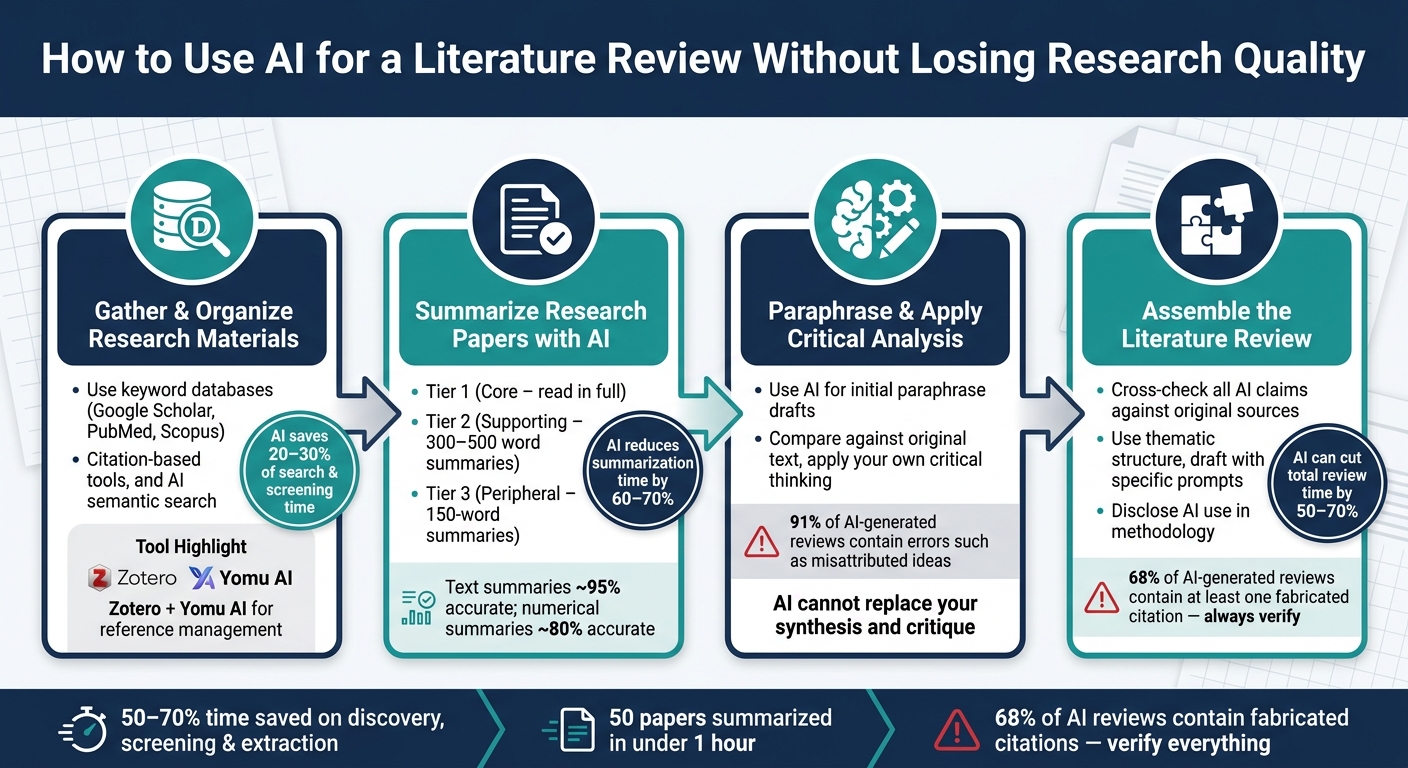
How to Use AI for a Literature Review: 4-Step Workflow
Literature Review + AI Tools - Here's What You Need to Know
sbb-itb-1831901
Step 1: Gathering and Organizing Research Materials
Before diving into writing your review, it's crucial to gather the right sources and have a solid system for managing them. Skipping this step can lead to a chaotic process - constantly searching for papers you've already read or losing track of where specific ideas came from. Start by sharpening your search techniques to collect only the most relevant materials.
How to Search Academic Databases Effectively
Using overly broad keywords can overwhelm you with irrelevant results. For example, searching "social media and mental health" might bring back thousands of papers, many of which won't be useful. Instead, refine your search terms. Something more specific, like "Instagram use and body image dissatisfaction in female undergraduates from 2020–2025," will yield results that are far more targeted.
Consider adopting a layered search strategy:
- Begin with keyword-based databases like Google Scholar, PubMed, or Scopus to gather a broad set of papers.
- Then, use citation-based tools to explore networks of related work. These tools allow you to find studies that cite or are cited by your "seed papers", uncovering connections you might otherwise miss.
- Leverage AI-powered semantic search tools to find papers based on concepts, even if they use different wording than your search terms. This approach can help bridge gaps that keyword searches might overlook.
"AI tools aren't replacing the need for human expertise, but they're dramatically reducing the time spent on mechanical aspects of the process." - Dr. Sophia Chen, Methodology Research Group at the Cochrane Collaboration
Using AI for search and abstract screening can save an estimated 20–30% of your time. However, don't rely on automation entirely. Always manually review borderline cases, as even the best tools can overlook important studies.
Importing and Managing References in Yomu AI
Once you've identified your sources, the next step is to organize them. A browser extension like Zotero Connector is a great tool for bulk-importing papers directly from academic databases. After collecting your sources, export them as a BibTeX (.bib) file, which is compatible with most AI tools. Make sure to include the "abstract" property in your export, as AI tools need this information to process the papers effectively.
Upload your BibTeX file into Yomu AI to centralize your data. Use Yomu AI's citation management tool to organize and format your references, streamlining the process as you move toward summarization and drafting. However, one critical step remains: always verify AI-generated citations against the original sources. Research has shown that 68% of AI-generated literature reviews contain at least one fabricated citation. Spot-checking your references isn't just recommended - it's non-negotiable.
Step 2: Using AI to Summarize Research Papers
With your sources organized in Yomu AI, you can extract key insights much faster. Reading full-text research papers word for word often isn’t practical, and skimming can lead to missed details. AI-powered summarization can reduce the time spent on this process by 60–70%. These summaries then become the groundwork for drafting your literature review.
Creating Clear, Focused Summaries
An effective summary should highlight the essential elements of a paper: the research question, methodology, findings, limitations, and conclusions. To streamline your work, categorize your sources into three tiers based on relevance:
- Core papers (Tier 1): These are essential to your review and should be read in full. Use AI here only to recall specific figures or double-check your understanding.
- Supporting papers (Tier 2): Summarize these in more detail, creating 300–500 word overviews. Focus on aspects like methodology, effect sizes, and the authors' interpretations.
- Peripheral papers (Tier 3): These provide background context or isolated data points. A brief 150-word summary should suffice.
After creating a summary, take 3–5 minutes to skim the original paper’s results and discussion sections to verify its accuracy. AI-generated summaries for numerical data are about 80% accurate, while text-based summaries can reach up to 95%. Double-check any critical statistics or details against the original source to avoid errors. From there, refine the summaries to align closely with your research focus.
Adjusting Summaries to Match Your Research Goals
A generic request like "summarize this paper" will give you a generic output. To make the summaries more relevant, provide Yomu AI with specific instructions. Mention your field, the theoretical framework you're using, the methodology you're focusing on, and the timeline of your research. For instance, instead of a broad request for a summary of a study on social media and anxiety, you could specify: "Summarize this paper’s methodology and findings in the context of cognitive behavioral frameworks in adolescent mental health research from 2018–2024."
You can also ask for specific data points, such as population size, intervention duration, measured outcomes, or limitations. This ensures the summary aligns with your inclusion criteria. If the result isn’t detailed enough, use Yomu AI’s refinement tools to dig deeper into a particular aspect, rather than starting over.
Dr. Leila Kumar, a neuroscience researcher, explains her approach:
"I use AI to generate a preliminary outline... But I never treat it as authoritative - it's more like having an informed colleague who sparks new investigative angles."
This mindset is key. AI-generated summaries are a helpful starting point, but they’re not the final answer for your literature review. Use them as a foundation, then build on them with your own analysis and insights.
Step 3: Paraphrasing and Applying Critical Analysis
At this stage, the goal is to rewrite your summaries in your own words while ensuring the essence and accuracy of the original content remain intact. This process emphasizes strong paraphrasing skills and underscores the dangers of relying too heavily on AI.
How to Paraphrase Using Yomu AI
Start by thoroughly understanding the passage before attempting to paraphrase. Highlight the section you want to rephrase and provide specific context to the AI. For example, you might instruct it to, "Paraphrase this passage in the context of social learning theory as applied to K–12 education research." This helps the AI produce a more targeted response.
However, treat the AI's output as a draft rather than a finished product. Always compare it to the original text to ensure accuracy. AI tools often rely on pattern recognition, which can lead to missed subtleties or slight misrepresentations of the original meaning. Once you have the paraphrased version, the next step is to assess its accuracy and depth critically.
Keeping Critical Thinking in the Loop
After generating a paraphrased draft, it's crucial to apply in-depth critical analysis. Just as summaries require careful review, paraphrased content must preserve the original message while allowing room for your unique perspective and analysis.
AI tools cannot substitute your ability to think critically. In fact, studies show that 91% of AI-generated literature reviews across five fields contained errors such as misattributing ideas to incorrect researchers.
"The value of your literature review lies in your original synthesis and critique, which AI cannot provide." – Yomu Resources
Once you've paraphrased, ensure the output aligns with the author's argument, acknowledges study limitations, and is consistent with other sources. These are aspects that AI cannot address independently. A study conducted in 2025 revealed that as researchers placed more trust in AI without questioning its outputs, their critical thinking weakened. Use Yomu AI as a tool to articulate and refine ideas you already understand, not as a shortcut for interpreting unfamiliar material.
Step 4: Putting AI Outputs Together Into a Literature Review
At this stage, the goal is to take the verified summaries, analyses, and references you've gathered and assemble them into a well-structured literature review. This process requires balancing efficiency with academic rigor. With AI-generated summaries, paraphrases, and references at your disposal, the challenge lies in organizing them into a cohesive and persuasive narrative.
Checking AI Outputs Against the Original Sources
Before diving into the drafting process, it’s critical to cross-check every AI-generated claim with the original sources. AI tools are known to occasionally produce fabricated citations or misattribute findings, which can seriously harm the credibility of your work.
"The danger of uncritical reliance on AI-generated literature reviews – they can introduce phantom knowledge that appears credible but undermines scientific integrity." - Dr. Elena Patel, Editor, Journal of Cognitive Neuroscience
Pay close attention to key statistical details like effect sizes, confidence intervals, and p-values. Always verify these against the original documents. If a citation seems unusually perfect for your argument, approach it with caution - AI is capable of creating plausible but inaccurate references.
To streamline the verification process, consider categorizing your sources into three tiers:
- Tier 1: Core papers you’ve read in full.
- Tier 2: Supporting papers where you’ve reviewed the results and discussion sections.
- Tier 3: Peripheral papers where you’ve checked AI summaries against the abstract.
This tiered system helps you focus your efforts on the most critical sources while ensuring that all information is accurate and reliable.
Once you’ve verified your sources, you can move on to drafting the review, using AI as a supportive tool.
Drafting Review Sections With Yomu AI
Yomu AI can assist in drafting sections of your review, particularly by helping with sentence completion and text refinement. A thematic structure often works best for literature reviews, as it allows you to group studies by shared ideas instead of summarizing each paper individually. This is where synthesis comes into play.
Rather than asking Yomu AI to produce a complete draft, use specific prompts to guide its output. For instance, you could request help with transitions, such as: "Suggest a sentence connecting the theme of self-regulated learning to metacognitive strategy research." Or you might ask it to "compare the methodologies of these two studies." This approach ensures that the AI remains a tool for brainstorming and drafting while you maintain control over the argument’s direction. As Dr. Leila Kumar explains:
"I use AI to generate a preliminary skeleton... But I never treat it as authoritative - it's more like having a conversation with a somewhat knowledgeable but occasionally confused colleague who gives me ideas to investigate properly." - Dr. Leila Kumar, Neuroscience Researcher
The table below highlights where AI writing aids can be most helpful during the drafting process and where human oversight is essential:
| Stage | Recommended AI Use | Human Oversight Required |
|---|---|---|
| Initial Exploration | Generate thematic categories and search terms | Ensure suggestions are broad and relevant |
| Source Validation | Summarize findings and extract data | Cross-check every reference with the original text |
| Content Integration | Suggest structural flow and transitions | Add critical analysis and evaluate methodologies |
| Final Preparation | Refine language and improve clarity | Confirm no unverified citations are added late |
Lastly, it’s important to clearly explain your use of AI tools in the methodology section of your review. Transparency about how AI was used and how its outputs were verified is not only a best practice but also a requirement for maintaining academic integrity at most institutions. By carefully integrating AI-generated content with your own analysis, you can ensure the quality and credibility of your literature review while setting a strong foundation for the next stages of your research.
Best Practices for Keeping Research Quality High When Using AI
What to Do to Get the Most Out of AI in Your Review
To maintain high research standards, let AI handle repetitive tasks like searching, screening, and summarizing. Save the more nuanced work - like evaluating methodologies, interpreting evidence, and forming arguments - for yourself. This division of labor ensures that AI supports, rather than replaces, the intellectual core of your research.
Write precise prompts. Clear and specific instructions are key to getting relevant AI-generated summaries. For example, instead of asking Yomu AI to "summarize this topic", try something more focused, like "highlight disagreements between these two studies on self-regulated learning" or "propose themes for these 12 papers on cognitive load." Vague prompts often result in generic or irrelevant outputs.
Run plagiarism checks for academic papers. AI tools, including GPT-3.5, have been shown to produce content that sometimes borrows too heavily from existing sources - 59.7% of outputs in one study contained some form of plagiarism. To avoid this, use Yomu AI's built-in plagiarism checker on drafts created with AI assistance. This step helps catch potential issues before submission.
Refine AI outputs iteratively. Review, correct, and re-prompt as needed to address errors or inaccuracies. This approach ensures the final content is precise and aligned with your research goals. The table below outlines these practices and highlights common pitfalls to watch out for.
"The question isn't whether AI will be used for literature reviews, but how it will be used. Some applications genuinely advance scholarly work, while others risk undermining its fundamental quality and trustworthiness." - Dr. Marcus Wei, Research Methodologist, Oxford University
Practices and Pitfalls at a Glance
| Practice | Benefit | Pitfall to Avoid |
|---|---|---|
| Custom Prompts | Ensures outputs are tailored to your research questions | Using vague instructions, leading to irrelevant results |
| Human Oversight | Maintains depth and rigor in analysis | Over-relying on AI for critical decisions |
| Plagiarism Checks | Protects against accidental misuse of sources | Failing to verify AI-paraphrased content |
| Iterative Refinement | Improves accuracy through feedback and corrections | Relying on a single-pass review, missing subtle errors |
| Citation Verification | Confirms all references are accurate and reliable | Accepting fabricated or incorrect citations at face value |
Conclusion: How to Use AI and Still Produce a Strong Literature Review
AI can reshape how literature reviews are conducted by automating repetitive tasks while leaving the critical thinking and analysis to researchers. It excels at tasks like evaluating sources, interpreting data, and summarizing findings, but the human touch remains essential for crafting a thoughtful and credible review.
The numbers make a strong case for AI's efficiency. For example, Yomu AI can cut the time spent on discovery, screening, and data extraction by 50–70%. It can also summarize 50 research papers in under an hour, a process that would usually take weeks. That said, speed shouldn't come at the expense of accuracy. As Dr. Aisha Johnson, a researcher in Science and Technology Studies, wisely notes:
"These tools aren't replacing the deep reading and critical thinking at the core of scholarship, but they might help researchers allocate their limited cognitive resources more strategically."
One major pitfall with AI is its potential to generate fabricated sources. This makes verifying citations and auditing statistical claims absolutely essential. Adding your own critical insights and ensuring the validity of AI-generated content are what elevate a literature review from being just a collection of facts to a meaningful, scholarly contribution.
Yomu AI is designed to complement this process with features like summarization, paraphrasing, citation formatting and plagiarism checking tools. By integrating these tools thoughtfully, you can streamline your workflow without compromising the integrity of your research. Use Yomu AI to support your next literature review and focus your energy where it matters most - on analysis and original argumentation.
FAQs
How do I verify AI-generated citations quickly?
To ensure the accuracy of AI-generated citations, take a moment to cross-check them against original sources or reliable academic databases. Look up details like the author, title, and publication date on trusted platforms such as Google Scholar or institutional repositories. Verify that the cited works not only exist but also align with the details provided. This manual check is crucial since AI tools can occasionally produce incorrect or outdated references. By doing this, you help maintain the integrity and quality of your research.
What’s the safest way to use AI summaries without missing key details?
The best approach to using AI summaries is to see them as a helpful starting point rather than a complete or final source. Always compare these summaries with the original papers to check for accuracy. You can also refine the AI's output by asking specific, targeted questions to guide its responses. While AI can save time by handling tasks like summarization, it's essential to manually review important sections to ensure no key details slip through. This way, you can balance efficiency with maintaining the quality of your research.
How should I disclose AI use in my literature review?
To uphold transparency and maintain academic integrity, it's important to openly acknowledge the use of AI in your literature review. For instance, you might include a statement like: “This document was created with assistance from AI tools and reviewed by a human.” Be specific about how and where AI was utilized, such as in study design, data collection, or drafting. Make sure your disclosure complies with the guidelines set by your institution or publication to ensure clarity and uphold research standards.