
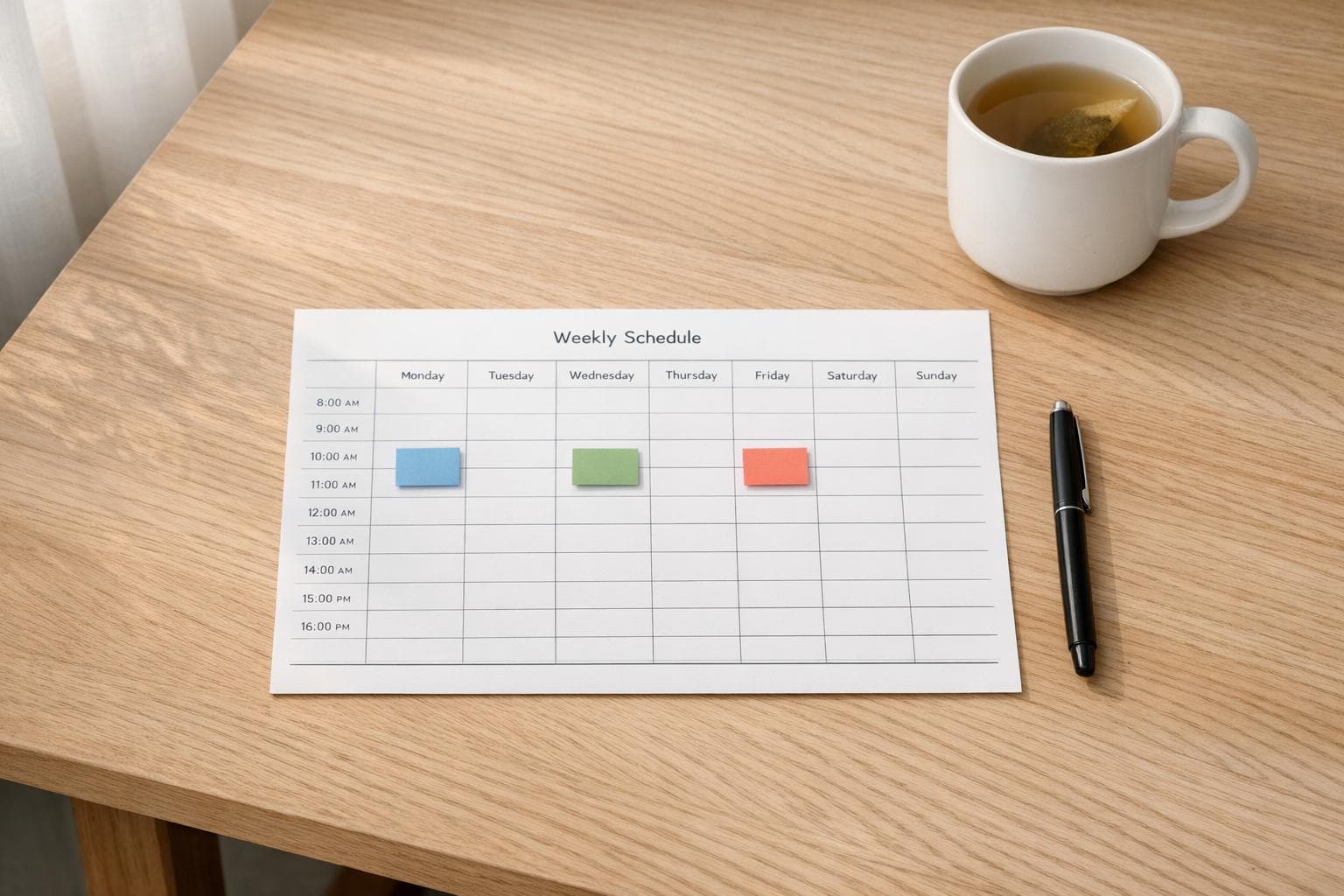
How to Create a Writing Schedule for Academic Work
Struggling to stay on top of academic writing? A structured writing schedule can help you manage deadlines, reduce stress, and improve productivity. Here's the key takeaway: break big tasks into smaller, manageable steps, dedicate specific time slots for writing, and stick to a consistent routine.
Quick Steps to Build Your Writing Schedule:
- Review Your Time: Map out your fixed commitments (classes, work, meals) and find open slots for writing.
- Estimate Task Time: Break projects into smaller tasks (e.g., research, drafting) and calculate how long each step will take.
- Pick a Scheduling Method: Use tools like calendars or apps to block time for writing and track your progress.
- Assign Specific Tasks: Plan clear, actionable goals for each session (e.g., "write 200 words" or "proofread introduction").
- Stay Flexible: Include buffer time for delays and review your schedule weekly to adjust as needed.
Consistency is key. Even 15 minutes a day can make a big difference over time. Stick to your plan, and you’ll see results without the last-minute panic.
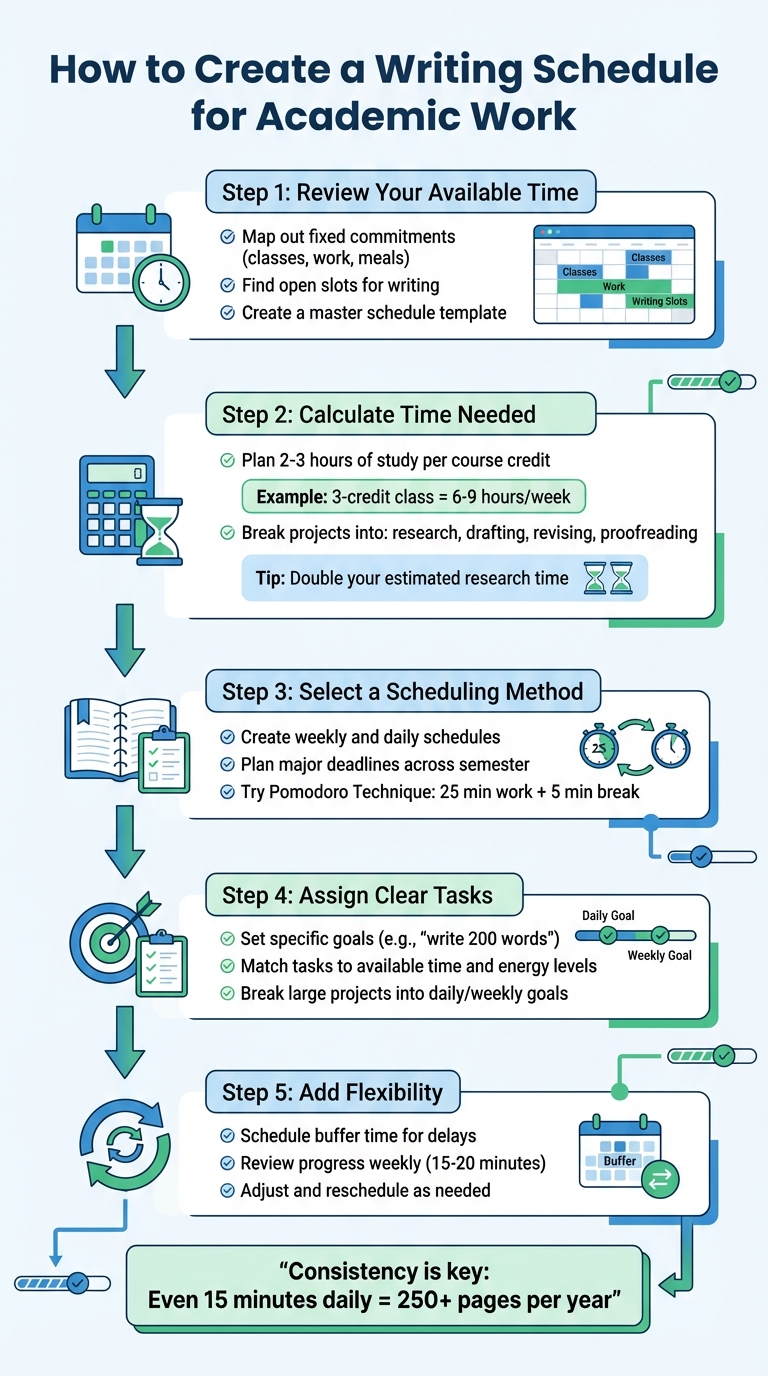
5-Step Process to Create an Academic Writing Schedule
How to Plan Your Academic Writing: Time Management Tips for PhD Students & Academics
Step 1: Review Your Available Time
Start by taking a close look at your weekly schedule. Separating fixed obligations from flexible ones will give you a clear picture of your time and help you create a writing routine that feels manageable rather than overwhelming.
List Your Fixed Commitments
Begin by identifying all the non-negotiable parts of your week - things like classes, work shifts, labs, meetings, and appointments. According to Utah State University, “schedule fixed blocks of time first. Start with classes, labs, meetings, and study time. Other activities such as work hours, social/extracurricular activities, and errands need to be scheduled around these”.
Don’t forget to include essential self-care activities like sleep, meals, and exercise. The Harvard Academic Resource Center reminds us: “Be sure to include all the things you need to do in a given day, not just your work”. These aren’t optional extras - they’re what keep you functioning at your best.
Using a visual template, divided into 30-minute or one-hour increments, can make this process easier. Once you’ve filled in all your recurring commitments, save this as your master schedule. It will serve as your baseline throughout the semester.
With your fixed commitments in place, you can now focus on finding the open spaces for writing.
Find Open Time Slots for Writing
Once your fixed schedule is mapped out, the remaining blank spaces are where your writing fits in. Instead of waiting for long, uninterrupted stretches of time, aim for shorter, regular writing sessions. The University of Pittsburgh Writing Institute suggests: “A writing session first thing in the morning ensures that you make writing a priority, but you might work better in the evening when your house is quiet”. Think about when you’re most alert and energized - use those peak hours for intensive drafting, and save less demanding tasks like formatting or proofreading for times when your energy dips (like the common 3:00 PM or 4:00 PM slump).
Once you’ve identified your writing slots, block them on your calendar and treat them as non-negotiable. Practice saying “no” to other commitments during these times. It’s also smart to build in buffer time - unexpected delays happen, and having a little wiggle room can keep your entire schedule from falling apart.
Step 2: Calculate Time Needed for Each Project
Now that you’ve mapped out your available time in Step 1, it’s time to figure out how much time each project will take. Misjudging this can lead to wasted hours or last-minute chaos. Break every assignment into manageable chunks, keeping its specific requirements in mind.
Estimate Weekly Hours per Assignment
A good rule of thumb is to plan 2–3 hours of study per course credit. For example, a 3-credit class typically requires 6–9 hours of weekly study time. As Oregon State University advises:
Plan 2-3 hours of study for each course credit. For a 3-credit class, this means 6-9 hours of study per week.
Of course, not all assignments are created equal. Writing a five-page research paper with ten sources will take significantly more time than a two-page reflection. Carefully review the details of each assignment - like page or word count and the number of sources - then divide the work into steps such as research, drafting, writing, revising, and proofreading. A helpful tip: double your estimated research time to account for unexpected delays. As noted by the University of Maryland Global Campus:
The more you write, the more familiar you'll be with how much time you, personally, need to write well.
At the start of the semester, it’s better to overestimate how long tasks will take. Track your actual time spent on assignments and adjust your estimates as you go. This way, you’ll get better at predicting your workload over time.
Adjust for Changing Workloads
Once you’ve estimated your time needs, it’s important to account for how workloads shift throughout the semester. Some weeks will be packed with deadlines, while others might be lighter. To stay ahead, create a Master Schedule at the start of the term that lists all major due dates. This bird’s-eye view helps you spot and prepare for those inevitable “crunch weeks.”
Include flex time in your weekly plan - blocks of time set aside for when tasks take longer than expected or when unforeseen issues pop up. Oregon State University emphasizes the value of this approach:
Flex time provides a cushion for when things don't go as planned, helping you stay on track without feeling overwhelmed.
When a high-priority project demands extra attention, consider borrowing time from lower-priority activities. If you fall behind, create a catch-up list that prioritizes critical tasks while postponing non-essential ones.
During especially demanding weeks, tailor your schedule to match your energy levels. For instance, if you’re too drained for heavy drafting, focus on lighter tasks like formatting or proofreading instead. Keep in mind that the creative process isn’t always linear - it often involves twists and turns. Your schedule should be flexible enough to accommodate that natural ebb and flow.
Step 3: Select a Scheduling Method
With a clear view of your available time and task estimates, it’s time to choose a scheduling method that supports your writing routine. A good system keeps you consistent and helps track your progress. Studies highlight that writing regularly, even in small amounts, is far more effective than irregular marathon sessions. Writing a little every day not only builds momentum but also reduces the need to reorient yourself with your project each time you sit down.
Create Weekly and Daily Schedules
Start by outlining your week with dedicated time blocks for writing. Begin with your non-negotiable commitments - like classes, work, meals, exercise, and sleep - so you can pinpoint open slots for writing. Next, identify your peak productivity hours, whether you’re a morning person or a night owl, and reserve these times for your most demanding writing tasks. Treat these sessions as unmissable appointments, like a meeting or doctor’s visit. If you skip one, make it a priority to reschedule.
Many successful writers aim to write at least five days a week, even if each session is as short as 15 minutes. Short, consistent sessions help you stay connected to your work. For daily goals, be specific - set targets like "write 200 words" or "annotate article X" rather than vague objectives like "work on chapter".
Plan Major Deadlines Across the Semester
Once your daily schedule is in place, layer in your academic deadlines to maintain a broader perspective on your workload. At the start of the semester, update a Master Schedule with key dates from your syllabi, such as tests, papers, and project deadlines. This high-level view helps you anticipate busy weeks and plan accordingly. As Cal Poly, San Luis Obispo explains:
The Master Calendar is a schedule constructed at the beginning of the quarter... It records important events such as tests, papers, projects... prepare for them in advance.
Don’t just record the final due dates - work backward to set internal deadlines for each phase of your project, like research, drafting, and revising. For example, if a paper is due on April 15, mark April 1 for completing the rough draft and March 25 for finishing your research. Use color-coding to differentiate between high-priority tasks and those that can be delayed if needed. Start preparing for major assignments and exams at least two to three weeks before they’re due to avoid last-minute stress.
Apply the Pomodoro Technique
The Pomodoro Technique is a simple yet effective way to manage your time. It divides work into focused intervals - typically 25 minutes - followed by short breaks. Each 25-minute session is called a "pomodoro." The basic cycle is: work for 25 minutes, take a 5-minute break, and repeat. After completing three to five pomodoros, take a longer break of 15–30 minutes.
This method is particularly helpful for academic writing because it encourages you to start, even when motivation is low, and builds discipline through consistency. To make the most of it, break large projects into smaller tasks - like writing a subsection or completing a specific word count - and estimate how many pomodoros each task will take. For instance, you might assign "Drafting Introduction = 2 pomodoros" to your day’s plan. Begin with an easier task, such as adding a familiar citation, to build momentum before tackling more challenging sections. Use the short breaks to stretch or walk around, which can help refresh your mind and improve focus for the next session. Tools like Pomofocus can simplify tracking your progress.
sbb-itb-1831901
Step 4: Assign Clear Tasks to Each Time Block
Make each writing session count by assigning specific, measurable tasks to your time blocks. Vague goals like "work on chapter 3" don’t give you a clear starting point or way to track progress. Instead, aim for precision: replace "work on chapter 3" with something like "synthesize citations on [topic] for literature review". This level of clarity reduces mental friction and helps you dive into work more effectively.
Match Tasks to Available Time
Once you’ve outlined clear tasks, match them to the time you have and your energy levels. Use shorter time blocks for quick, focused tasks and reserve longer stretches for deep, uninterrupted work. For example, low-energy times are perfect for tasks like responding to emails or verifying citations, while high-energy periods should be dedicated to more demanding activities.
Feeling overwhelmed? Try the 15-minute rule: commit to a small, manageable task, such as "proofreading page one" or "drafting a thesis statement." The University of Illinois Writers Workshop highlights:
typically, once we begin the physical act of writing, the cognitive processes will kick into gear.
Often, taking that first small step can lead to a productive groove.
Break Projects into Smaller Tasks
Divide large assignments into manageable daily or weekly goals. For example, if you’re working on a standard paper, you could structure your week like this:
- Day 1: Brainstorm and refine your topic
- Day 2: Conduct research and create an outline
- Day 3: Write a rough draft
- Day 4: Revise and proofread
This approach keeps you moving forward without feeling overwhelmed.
Turn passive tasks into active steps. Instead of just "reading", set a goal like "write annotations for article X" or "type up notes from three sources". During drafting, aim for specific word count targets to measure progress. As you move into revision, shift your focus to actionable goals, such as "incorporate three professor comments" or "ensure each topic sentence connects to the thesis". These small, focused tasks help you build momentum and maintain a steady writing routine.
Step 5: Add Flexibility and Regular Reviews
Even the best-laid plans need some wiggle room. Writing is rarely a straightforward journey - it often loops back to brainstorming or extra research, even after you've started drafting. By building flexibility into your schedule, you can handle these natural detours without losing momentum.
Schedule Extra Time for Delays
Set aside unassigned "buffer time" in your weekly calendar. Think of these as safety nets for when tasks take longer than expected or when surprises pop up. Your initial time estimates might not always hit the mark, but as you track your progress, you can adjust them.
If you miss a planned writing session, don’t just skip it - reschedule it as soon as possible. When you're pressed for time, reprioritize by trimming flexible activities like social plans rather than sacrificing sleep or your dedicated writing blocks. Avoid dumping unfinished tasks onto the next day’s list; instead, revise your plan to reflect what’s realistically achievable. These small adjustments keep your schedule manageable and adaptable.
Assess Your Schedule Each Week
At the end of every week, take 15–20 minutes to evaluate what worked and what didn’t. Note any deviations and their reasons - was the task harder than expected? Did distractions throw you off?
Weekly reviews help you fine-tune your schedule as you go. Oregon State University encourages students to stay optimistic:
Try not to get discouraged if your schedule gets off track one week. Take a step back, assess your system, and try again!
Use what you learn to create a more accurate plan for the next week. Over time, this process will help you develop a rhythm that aligns with how you actually work, rather than how you wish you worked.
Tools and Resources for Scheduling
Once you've mapped out your schedule, the next step is finding the right tools to support your writing routine. The right tools help you stick to your plan and make the process more efficient. They work alongside your schedule, reinforcing good time management habits.
Digital and Physical Planning Options
Digital tools like Google Calendar, Notion, and Obsidian are great for organizing deadlines and setting aside dedicated writing blocks. Features like color-coding can make it easier to visualize your workload at a glance.
Prefer something you can hold in your hands? Printable templates in PDF or MS Word formats provide a clear weekly or semester overview. Some people find that physically writing tasks down helps them stay committed to their plans.
To stay focused during your scheduled writing times, distraction-blocking apps like StayFocused, Cold Turkey, SelfControl, or Freedom can limit access to social media and other time-wasting sites. If you're looking for a fun way to track your progress, apps like Habitica turn your writing sessions into a game, rewarding consistency and making the process more engaging.
Boost Productivity with Yomu AI

For drafting faster and managing citations effortlessly, Yomu AI is a powerful tool. It simplifies academic writing with features like AI-powered autocomplete, automated citation formatting, and a plagiarism checker to ensure your work meets academic standards. These tools can help you overcome writer’s block and produce content more efficiently.
One helpful tip: adding exact citations early in your draft saves you from the hassle of manual formatting later. Yomu AI's citation tool takes care of this for you, while its plagiarism checker ensures your work is ready for submission. By automating these tasks, Yomu AI allows you to maintain steady progress and hit your daily writing goals - avoiding the stress of last-minute cramming sessions.
Conclusion
Once you've outlined your time slots, estimated tasks, and reviewed your methods, the key is to bring these practices together and stick with them. Consistency beats intensity every time. Studies show that steady, regular sessions - not marathon writing sprees - are what lead to productive academic writing. Even dedicating just 15 minutes a day or committing to writing one page, five days a week, can result in over 250 pages by the end of the year.
To recap the scheduling process: start by mapping out your fixed commitments, then identify open time slots for writing. Break big projects into smaller, actionable tasks - like "summarize three sources" instead of a vague goal like "work on chapter." Schedule these writing sessions during your peak energy hours, whether that's early in the morning or late at night, and treat them like non-negotiable appointments.
"Treat this like any other important appointment - one that you can't miss." - IUP Center for Scholarly Communication
Don’t forget to allow buffer time for unexpected delays, and review your progress weekly. If you hit writer’s block, tackle the easiest task on your list - like formatting a bibliography or proofreading a single paragraph - to get the ball rolling. Tools like Yomu AI can help simplify citation formatting and plagiarism checks, letting you focus your energy on the creative aspects of writing.
FAQs
How can I adjust my writing schedule during busy weeks?
To keep your productivity up during hectic weeks, aim for short, regular writing sessions instead of marathon stretches. This way, you can chip away at your goals without getting overwhelmed or drained.
Figure out your most productive hours - those times when you feel sharp and focused - and plan your writing around them. Tackle tasks based on deadlines and priority, but stay flexible enough to adjust as needed. Striking a balance between routine and adaptability can help you stay on track, even when things get busy.
How can I stay motivated and consistent with my academic writing schedule?
Staying motivated and sticking to your academic writing routine starts with building a schedule that suits your natural productivity patterns. Are you a morning person? Or do you find your creative energy peaks in the evening? Pinpoint your most productive hours and dedicate that time to writing. Treat these sessions as non-negotiable appointments, and take steps to limit distractions - turn off notifications, put your phone out of reach, and steer clear of social media.
Start small to build momentum. For example, commit to writing for just 15 minutes a day at first. Once it becomes a habit, you can gradually increase the time. The key is consistency, not marathon sessions. Show up regularly, and you’ll make steady progress. While life may sometimes require you to adjust your schedule, aim to keep a steady rhythm to stay motivated and maintain progress.
If you need extra help, tools like Yomu AI can simplify the academic writing process. With features like text enhancement, citation formatting, and a plagiarism checker, these tools can save you time and help you stay focused on achieving your writing goals.
How can the Pomodoro Technique help me stay focused while writing for academic work?
The Pomodoro Technique is a simple yet effective way to manage your time and boost productivity. It works by dividing your work into focused intervals - typically 25 minutes of concentrated effort followed by a 5-minute break. After completing four of these cycles, you reward yourself with a longer break, usually lasting 15 to 30 minutes, to recharge.
Here’s how to put it into action: set a timer for 25 minutes and dedicate that time to writing without interruptions. When the timer rings, take a quick 5-minute break to stretch, grab a drink, or simply relax. This rhythm not only helps you maintain focus but also prevents burnout, making it easier to tackle even the most daunting academic projects in manageable steps.
To make your writing sessions even smoother, you might want to explore tools like Yomu AI. With features like sentence autocompletion, paraphrasing, citation formatting, and a robust plagiarism checker, Yomu AI can be a game-changer for keeping your academic writing efficient and stress-free.